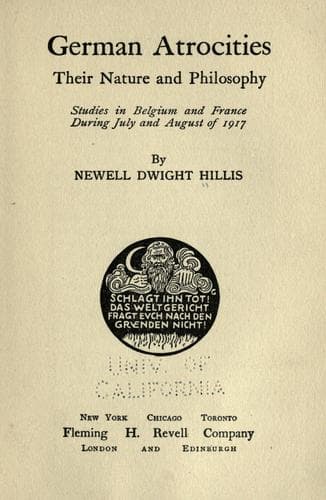
German Atrocities: Their Nature and PhilosophyHillis, Newell Dwight
History
German Atrocities: Their Nature and Philosophy
Hillis, Newell Dwight
Pangermanism; World War, 1914-1918; World War, 1914-1918 -- Atrocities
The French peasants loved their land and then lost it. One morning the
Hun stood at the gate. The farmers with their pruning knives were no
match for Germans with their machine guns, and down they fell under
the plum trees they were pruning. The devastated regions of France are
like unto a world ruined by devils. The Germans cut down the apples,
the pears, and all the peaches. They did not spare the cherry, the
quince, the gooseberry and currant, or the vineyards. Gone also all the
beautiful bridges--they have been dynamited! Gone all the lovely and
majestic Thirteenth Century churches! Gone all the galleries, for some
of the finest art treasures in the world have perished.
The land has been put back to where it was when Julius Cæsar described
it two thousand years ago--a wild land, and waste, growing up with
thorns and thistles. That proclamation on a wall tells the whole
story. "Let no building stand, no vine or tree. Before retreating see
that the wells and springs are plentifully polluted with corpses and
with creasote." The spirit was this, "Since we Germans cannot have this
land, no one else shall."
PRINCE EITEL'S CRIME
But there is more. One of the historic chateaux is that of Avricourt,
rich in noble associations of history. It was one of the class of
buildings covered by a clause in the international agreements between
Germany, France and the United States and all the civilized nations,
safeguarding historic buildings. For many months it was the home of
Prince Eitel, the Kaiser's second son.
Public-domain text, read in full here on John Shaqi.
Reviews
Reviews
No reviews yet
Be the first to share your thoughts on this work.
Join the Discussion
Join the discussion
Sign in to leave a comment or review.
Sign InorCreate an account