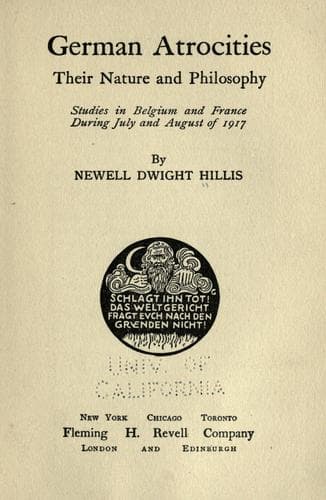
German Atrocities: Their Nature and PhilosophyHillis, Newell Dwight
History
German Atrocities: Their Nature and Philosophy
Hillis, Newell Dwight
Pangermanism; World War, 1914-1918; World War, 1914-1918 -- Atrocities
But imagination is not her gift. If Sheffield can give her a model
knife, Germany can reproduce that knife in quantities and undersell
Sheffield. The German people keep step in a regiment, in a factory and
on a ship, and therefore are wholesalers. The French mind is creative.
It stands for individual excellence, and is at the other extreme from
the German temperament. The emblem of the German intellect is beer; the
emblem of the English intellect is port wine; the emblem of the French
mind is champagne; the emblem of an American intellect like Emerson's
is a beaker filled with sunshine--but Germany has a "beer" mind. It
is this lack of imagination that explains Nietzsche's statement that
for two hundred years Germany has been "the enemy of culture" while
Heinrich Heine insists that "the very name of culture is France."
It is this total lack of any appreciation of art and architecture that
explains Germany's destruction of some of the noblest buildings of
the world. She cannot by any chance conceive how the other races look
upon her vandalism. Her own foreign secretary expressed it publicly
in one of her state papers, "Let the neutrals cease chattering about
cathedrals. Germany does not care one straw if all the galleries and
churches in the world were destroyed, providing we gain our military
ends." Guizot in his history of civilization presents three tests of a
civilized people: First, they revere their pledges and honour; second,
they reverence and pursue the beautiful in painting, architecture and
literature; third, they exhibit sympathy in reform towards the poor,
the weak and the unfortunate.
Now apply those tests to the Kaiser and his War Staff, and you
understand why Rheims Cathedral is a ruin.[2] No building since the
Parthenon was more precious to the world's culture. What majesty and
dignity in the lines! What a wealth of statuary! How wonderful the
Twelfth Century glass! With what lightness did these arches leap into
the air! Now, the great bombs have torn holes through the roof; only
little bits of glass remain; broken are the arches, ruined these
flying buttresses, the altar where Jeanne d'Arc stood at the crowning
of Charles is quite gone. The great library, the bishop's palace, all
the art treasures are in ruins. But ancient and noble buildings do
not belong to a race, they belong to the world. Sacred forever the
threshold of the Parthenon, once pressed by the feet of Socrates and
Plato! Thrice sacred that aisle of Santa Croce in Florence, dear to
Dante and Savonarola. To be treasured forever the solemn beauty of
Westminster Abbey, holding the dust of men of supreme genius.
Public-domain text, read in full here on John Shaqi.
Reviews
Reviews
No reviews yet
Be the first to share your thoughts on this work.
Join the Discussion
Join the discussion
Sign in to leave a comment or review.
Sign InorCreate an account