German Atrocities: Their Nature and Philosophy — John Shaqi
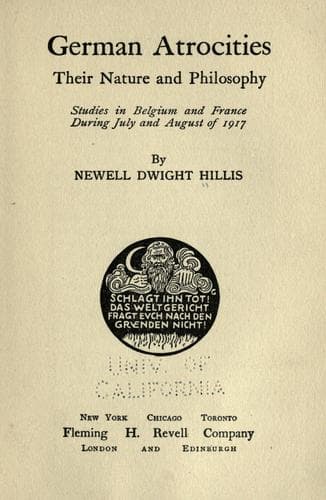
German Atrocities: Their Nature and PhilosophyHillis, Newell Dwight
History
German Atrocities: Their Nature and Philosophy
Hillis, Newell Dwight
Pangermanism; World War, 1914-1918; World War, 1914-1918 -- Atrocities
Having entered upon war as her chief national industry, and looking
with greedy eyes upon the steel plants, the looms and factories of
rich Belgium; envying France her unique supremacy as the leader of
the fine arts; tempted by the little states like Holland and Denmark
on the west and Rumania and Poland on the east, states that seemed
like purple clusters, bursting with wine for German lips, it became
necessary for Germany to find a philosophy that would break down the
great convictions of morality inherited from Martin Luther.
All wise men trace deeds back to the thinking of the doer, just as
they trace bitter water back to a poisoned spring. Of the German
teaching of Prussianism we can only say, no grapes from Prussian
thorns, no figs from Prussian thistles. What the Prussians thought in
their hearts, that they became in their lives. What began as sparks
of avarice and ambition has ended in this world conflagration, and
Germany is responsible, not for the sparks, but for the world ruin.
Alcibiades and Catiline and Benedict Arnold all thought in terms of
selfishness, and they all did cruel deeds. The murder of Edith Cavell
and Captain Fryatt, the sinking of women and children on steamers, the
rape of Belgium and Northern France, the assassination of Poland, the
deliberate, cold-blooded plots by the German officers with the Turkish
soldiers to exterminate the Armenians, so that they could settle on the
lands, are the outer exhibition in deeds of the inner philosophy of the
Germans. That is why their favorite philosopher Nietzsche says that
Germany's gift is brute force and not intellect. ("Ecce Homo," page 38,
and page 134: "Wherever Germany extends her sway, she ruins culture. I
feel it my duty to tell the Germans that every crime against culture
lies on their conscience.")
A philosophy therefore was concocted, called "Prussianism." This
philosophy is no secret, for Germany has trumpeted it forth, from the
top of the palace in Potsdam and the Dom in Berlin. For fifteen years
it has been the very essence of the teaching in her universities, her
pulpit, her press and her Parliament. This is its substance: Over
against Martin Luther's conception of God as the All-wise and Good
Father, who is righteous Himself, and demands righteousness of His
children, the new philosophy sets up the political State as the be-all
and end-all for the German people. Omnipotence means a Kaiser's arm,
with that of a war staff, carried up to the nth degree of power by
seventy millions of other arms.
Public-domain text, read in full here on John Shaqi.
Reviews
Reviews
No reviews yet
Be the first to share your thoughts on this work.
Join the Discussion
Join the discussion
Sign in to leave a comment or review.
Sign InorCreate an account