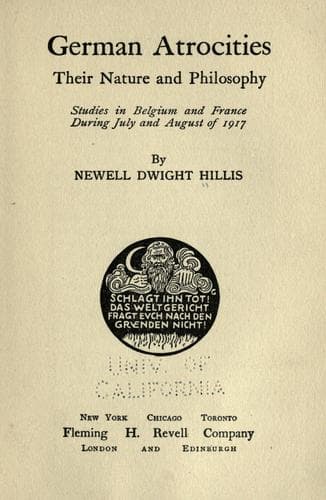
German Atrocities: Their Nature and PhilosophyHillis, Newell Dwight
History
German Atrocities: Their Nature and Philosophy
Hillis, Newell Dwight
Pangermanism; World War, 1914-1918; World War, 1914-1918 -- Atrocities
Not less striking the influence of Germany's philosophy and her
Pan-German empire scheme upon her diplomats in foreign countries.
We need not take the opinion of the British or Belgian, the French
or American authors. It is enough to ask for the testimony of the
Germans themselves. One of the most important documents bearing
upon this war is a volume of reminiscences published seven years
before the war began, but practically unknown in the United States.
This volume is entitled "Experiences at a German Embassy; ten years
of German-American diplomacy," by Emil Witte, late counsellor of
litigation; Leipzig, 1907. Probably not more than two or three thousand
of the author's friends ever bought a copy of this book, but the volume
spreads out before us like a black map the fact that for ten years von
Holleben and Münsterberg with their German associates were steadily
building up the organization of all German Americans preparatory to a
time when the war between the United States and Germany would partake
the character of a Civil War.
This counsellor of litigation tells us that on the German day, October
6, 1901, Germanism in the United States was organized at Philadelphia.
The diplomat then tells us how, directed by the German Ambassador, he
went up and down the United States organizing in New York, Brooklyn,
Chicago, Milwaukee, Cincinnati and St. Louis the German Soldiers'
Societies of the United States, and wooing the German-Americans over
to the point where they would see that their first allegiance was
to the Fatherland, their second to the United States. The German
foreign office and the Kaiser were constantly sending von Holleben
for German-Americans flags, decorations, gracious letters, medals,
invitations to visit Germany and meet the Royalty--methods that
culminated in the German law that made it possible for pro-Germans
in this country and for their sons despite American citizenship to
keep their German citizenship with all the rights of suffrage in the
Fatherland. Very significant also one sentence in these reminiscences
of this German diplomat: "The relations between Official Germany and
the emigrant subjects of the Emperor, whether they have become citizens
of the Republic or not, may lead to serious complications between
Germany and the United States, and to unforeseen incidents which at any
moment may involve both powers in serious difficulty."
Public-domain text, read in full here on John Shaqi.
Reviews
Reviews
No reviews yet
Be the first to share your thoughts on this work.
Join the Discussion
Join the discussion
Sign in to leave a comment or review.
Sign InorCreate an account