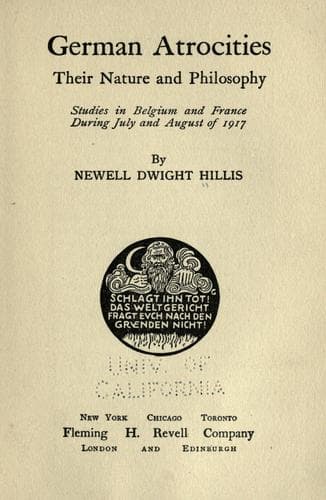
German Atrocities: Their Nature and PhilosophyHillis, Newell Dwight
History
German Atrocities: Their Nature and Philosophy
Hillis, Newell Dwight
Pangermanism; World War, 1914-1918; World War, 1914-1918 -- Atrocities
In the "summarizing report by the General War Staff," published
December 31, 1914, the German chief says in explanation of the Belgian
campaign: "The need of the German army to push through Belgium was
imperative. Our starting point was that the tactical object of the
Twelfth Corps was to cross the Meuse with speed. To at once overcome
the opposition of the inhabitants was a military necessity, and
something to be striven for in every way." And what does "every way"
mean? Let the German Staff themselves answer. "The flourishing town
of Dinant with its suburbs was burnt, and made a heap of ruins, and
a large number of Belgian lives lost." "About 220 inhabitants were
then shot, and the village was burned. Just now, six o'clock in the
afternoon, the crossing of the Meuse begins near Dinant; all the
suburbs, chateaux and houses were burned down during this night. It
was a beautiful sight to see the villages burning all around us in the
distance." "The town appeared to be perfectly peaceful, nevertheless,
for the sake of security, a number of the inhabitants were made
prisoners by the grenadiers." "Later, we decided to assemble all the
male hostages against the garden wall, where we shot them."
Hundreds of witnesses called in one town, after the Germans had passed
on, show that the German officers and soldiers were engaged in one
horrible orgy of pillage, drunkenness, lust and murder. They began
by breaking open all wine cellars and soon the officers went reeling
and staggering through the streets, firing their revolvers into
the windows of houses and stores. They blasted the safes open with
dynamite. They carried goods from the shelves to the freight trains,
and as fast as the town was pillaged, burned the houses. During four
days they looted and burned twelve hundred houses, stores, factories,
schools and churches. They left lying on the ground seven hundred dead
bodies, chiefly women and children. Two trains laden with the men and
women who were strong enough to work were carried off to Germany.
All the manufactories where the artisan class were wont to work were
systematically destroyed. Marching away from towns that were blazing
furnaces, the German soldiers drove in advance a long line of women
and children, with a few aged men, and used them as screens behind
which they could march into the next town that was to be looted.
THE LOOTING OF LOUVAIN
Public-domain text, read in full here on John Shaqi.
Reviews
Reviews
No reviews yet
Be the first to share your thoughts on this work.
Join the Discussion
Join the discussion
Sign in to leave a comment or review.
Sign InorCreate an account