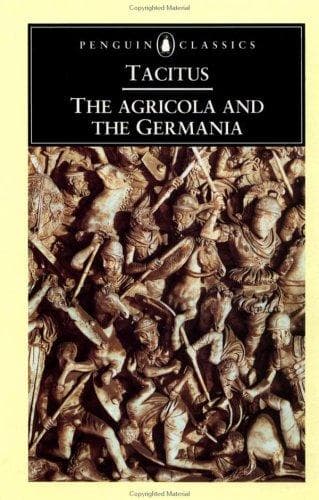
Agricola, Gnaeus Julius, 40-93; Germanic peoples -- Early works to 1800; Statesmen -- Rome -- Biography -- Early works to 1800
_Suspiria--subscriberentur. When our sighs_ (of sympathy with the
condemned) _were registered against us_ (by spies and informers, as a
ground of accusation before the Emperor).
_Rubor_. Redness, referring to the complexion of Dom., which was such as
to conceal a blush, cf. Suet. Dom. 18: vultu ruboris pleno.
_Opportunitate mortis_. An expression of Cic., in the similar passage
above cited (de Orat. 3, 2, 8), touching the death of Crassus.
_Pro virili portione_, lit. for one man's share, referring primarily to
pecuniary assessments. Here: _for thy part--so far as thou wast
concerned_. A. died with a calmness which would scarcely admit of the
supposition, that he felt himself to be a victim of poison and imperial
jealousy.
_Filiaque ejus_. The apostrophe is here dropped to be resumed at _optime
parentum_. So the MSS. For they read _ejus_ here, and _amissus est_
below. Rhenanus omitted _ejus_, and wrote _es_ for _est_; and he has been
followed in the common editions since.
_Conditione_. By the circumstance, or by virtue of our long absence. T.
and his wife had parted with A. four years before his death, and had been
absent from Rome ever since, where or why does not appear.
_Superfuere_. Cf. _superest_, G. 6, note.
XLVI. _Sapientibus_. Cf. _sapientiae professoribus_, 2, note.--_Te
immortalibus laudibus_. I feel constrained to recur to the reading of
Lipsius and Ritter, it is so much more spirited than _quam temporalibus_.
_Potius_ manifestly should refer back to _lugeri_ and _plangi_. The
comparison contained in the more common reading is uncalled for in the
connection, and of little significance in itself. The MSS. read
_temporalibus laudibus_ without _quam_ and this may be more easily
resolved into _te immortalibus_, than _quam_ can be supplied.--
_Similitudine_. Al. aemulatione. For such a use of similitudo, cf. Cic.
Tusc. Quaest. 1, 46, 110: quorum (sc. Curii, Fabricii, Scipionum, etc.),
_similitudinem_ aliquam qui arripuerit, etc.
_Decoremus_. Ennius (cited by Cic. Tusc. Q. 1, 49, 117, and de Senect.
20, 73), uses the same word in expressing the same sentiment: nemo me
lacrumis _decoret_ nec funera fletu faxit. Cf. also G. 28.
_Formam_. This makes the sense so much better (than _famam_), that E. Dr.
Wr. R. and most others have adopted it against the authority of the MSS.
cf. _forma mentis_, below, and Cic. passim.
_Intercedendum. To be prohibited_. Properly said of a _veto interposed_
by the Tribunes; then of any prohibition.--_Non quia==not that_, is
characteristic of late writers. It is followed by the subj. Z. 537, and
note H. 1, 15.
_Manet, mansurumque est_. Cf. Vell. Paterc. 2, 66, 5: vivit, vivetque per
omnem saeculorum memoriam. The periphrastic form (_mansurum est_) differs
however from the future (_manebit_), as our _is to remain_ from _will
remain_. See Z. 498.
Public-domain text, read in full here on John Shaqi.
Reviews
Reviews
No reviews yet
Be the first to share your thoughts on this work.
Elsewhere in the archive
Join the Discussion
Join the discussion
Sign in to leave a comment or review.
Sign InorCreate an account