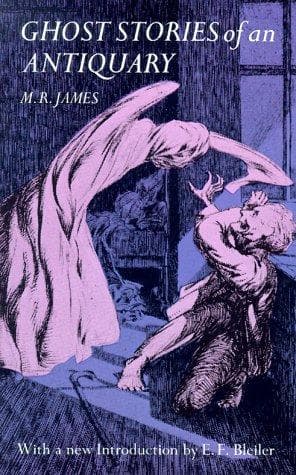
Ghost Stories of an AntiquaryJames, M. R. (Montague Rhodes)
General
Ghost Stories of an Antiquary
James, M. R. (Montague Rhodes)
Ghost stories, English; Horror tales, English; Short stories, English
Inexpressibly frightened as he was, he determined to take his candle
and go down to Mr Abney’s study, for the hour appointed for their
meeting was near at hand. The study or library opened out of the
front-hall on one side, and Stephen, urged on by his terrors, did not
take long in getting there. To effect an entrance was not so easy. It
was not locked, he felt sure, for the key was on the outside of the
door as usual. His repeated knocks produced no answer. Mr Abney was
engaged: he was speaking. What! why did he try to cry out? and why was
the cry choked in his throat? Had he, too, seen the mysterious
children? But now everything was quiet, and the door yielded to
Stephen’s terrified and frantic pushing.
On the table in Mr Abney’s study certain papers were found which
explained the situation to Stephen Elliott when he was of an age to
understand them. The most important sentences were as follows:
“It was a belief very strongly and generally held by the ancients—of
whose wisdom in these matters I have had such experience as induces me
to place confidence in their assertions—that by enacting certain
processes, which to us moderns have something of a barbaric complexion,
a very remarkable enlightenment of the spiritual faculties in man may
be attained: that, for example, by absorbing the personalities of a
certain number of his fellow-creatures, an individual may gain a
complete ascendancy over those orders of spiritual beings which control
the elemental forces of our universe.
“It is recorded of Simon Magus that he was able to fly in the air, to
become invisible, or to assume any form he pleased, by the agency of
the soul of a boy whom, to use the libellous phrase employed by the
author of the _Clementine Recognitions_, he had ‘murdered’. I find it
set down, moreover, with considerable detail in the writings of Hermes
Trismegistus, that similar happy results may be produced by the
absorption of the hearts of not less than three human beings below the
age of twenty-one years. To the testing of the truth of this receipt I
have devoted the greater part of the last twenty years, selecting as
the _corpora vilia_ of my experiment such persons as could conveniently
be removed without occasioning a sensible gap in society. The first
step I effected by the removal of one Phoebe Stanley, a girl of gipsy
extraction, on March 24, 1792. The second, by the removal of a
wandering Italian lad, named Giovanni Paoli, on the night of March 23,
1805. The final ‘victim’—to employ a word repugnant in the highest
degree to my feelings—must be my cousin, Stephen Elliott. His day must
be this March 24, 1812.
Public-domain text, read in full here on John Shaqi.
Reviews
Reviews
No reviews yet
Be the first to share your thoughts on this work.
Join the Discussion
Join the discussion
Sign in to leave a comment or review.
Sign InorCreate an account