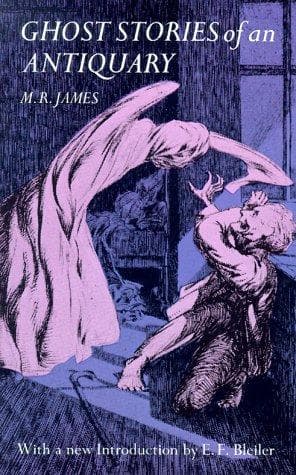
Ghost Stories of an AntiquaryJames, M. R. (Montague Rhodes)
General
Ghost Stories of an Antiquary
James, M. R. (Montague Rhodes)
Ghost stories, English; Horror tales, English; Short stories, English
hunched in a continual nervous contraction, as if he were expecting
every moment to find himself in the clutch of an enemy. The Englishman
hardly knew whether to put him down as a man haunted by a fixed
delusion, or as one oppressed by a guilty conscience, or as an
unbearably henpecked husband. The probabilities, when reckoned up,
certainly pointed to the last idea; but, still, the impression conveyed
was that of a more formidable persecutor even than a termagant wife.
However, the Englishman (let us call him Dennistoun) was soon too deep
in his note-book and too busy with his camera to give more than an
occasional glance to the sacristan. Whenever he did look at him, he
found him at no great distance, either huddling himself back against
the wall or crouching in one of the gorgeous stalls. Dennistoun became
rather fidgety after a time. Mingled suspicions that he was keeping the
old man from his _déjeuner_, that he was regarded as likely to make
away with St Bertrand’s ivory crozier, or with the dusty stuffed
crocodile that hangs over the font, began to torment him.
“Won’t you go home?” he said at last; “I’m quite well able to finish my
notes alone; you can lock me in if you like. I shall want at least two
hours more here, and it must be cold for you, isn’t it?”
“Good heavens!” said the little man, whom the suggestion seemed to
throw into a state of unaccountable terror, “such a thing cannot be
thought of for a moment. Leave monsieur alone in the church? No, no;
two hours, three hours, all will be the same to me. I have breakfasted,
I am not at all cold, with many thanks to monsieur.”
“Very well, my little man,” quoth Dennistoun to himself: “you have been
warned, and you must take the consequences.”
Before the expiration of the two hours, the stalls, the enormous
dilapidated organ, the choir-screen of Bishop John de Mauléon, the
remnants of glass and tapestry, and the objects in the
treasure-chamber, had been well and truly examined; the sacristan still
keeping at Dennistoun’s heels, and every now and then whipping round as
if he had been stung, when one or other of the strange noises that
trouble a large empty building fell on his ear. Curious noises they
were sometimes.
“Once,” Dennistoun said to me, “I could have sworn I heard a thin
metallic voice laughing high up in the tower. I darted an inquiring
glance at my sacristan. He was white to the lips. ‘It is he—that is—it
is no one; the door is locked,’ was all he said, and we looked at each
other for a full minute.”
Another little incident puzzled Dennistoun a good deal. He was
examining a large dark picture that hangs behind the altar, one of a
series illustrating the miracles of St Bertrand. The composition of the
picture is well-nigh indecipherable, but there is a Latin legend below,
which runs thus:
_Qualiter S. Bertrandus liberavit hominem quem diabolus diu volebat
strangulare_. (How St Bertrand delivered a man whom the Devil long
sought to strangle.)
Public-domain text, read in full here on John Shaqi.
Reviews
Reviews
No reviews yet
Be the first to share your thoughts on this work.
Join the Discussion
Join the discussion
Sign in to leave a comment or review.
Sign InorCreate an account