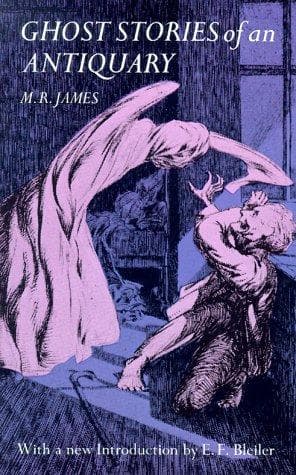
Ghost Stories of an AntiquaryJames, M. R. (Montague Rhodes)
General
Ghost Stories of an Antiquary
James, M. R. (Montague Rhodes)
Ghost stories, English; Horror tales, English; Short stories, English
With these words the excellent man went to continue the round of his
masters, and you may be sure the gentlemen whom he left lost no time in
gathering round the engraving. There was the house, as before, under
the waning moon and the drifting clouds. The window that had been open
was shut, and the figure was once more on the lawn: but not this time
crawling cautiously on hands and knees. Now it was erect and stepping
swiftly, with long strides, towards the front of the picture. The moon
was behind it, and the black drapery hung down over its face so that
only hints of that could be seen, and what was visible made the
spectators profoundly thankful that they could see no more than a white
dome-like forehead and a few straggling hairs. The head was bent down,
and the arms were tightly clasped over an object which could be dimly
seen and identified as a child, whether dead or living it was not
possible to say. The legs of the appearance alone could be plainly
discerned, and they were horribly thin.
From five to seven the three companions sat and watched the picture by
turns. But it never changed. They agreed at last that it would be safe
to leave it, and that they would return after Hall and await further
developments.
When they assembled again, at the earliest possible moment, the
engraving was there, but the figure was gone, and the house was quiet
under the moonbeams. There was nothing for it but to spend the evening
over gazetteers and guide-books. Williams was the lucky one at last,
and perhaps he deserved it. At 11.30 p.m. he read from Murray’s _Guide
to Essex_ the following lines:
16½ miles, _Anningley_. The church has been an interesting building of
Norman date, but was extensively classicized in the last century. It
contains the tomb of the family of Francis, whose mansion, Anningley
Hall, a solid Queen Anne house, stands immediately beyond the
churchyard in a park of about 80 acres. The family is now extinct, the
last heir having disappeared mysteriously in infancy in the year 1802.
The father, Mr Arthur Francis, was locally known as a talented amateur
engraver in mezzotint. After his son’s disappearance he lived in
complete retirement at the Hall, and was found dead in his studio on
the third anniversary of the disaster, having just completed an
engraving of the house, impressions of which are of considerable
rarity.
This looked like business, and, indeed, Mr Green on his return at once
identified the house as Anningley Hall.
“Is there any kind of explanation of the figure, Green?” was the
question which Williams naturally asked.
Public-domain text, read in full here on John Shaqi.
Reviews
Reviews
No reviews yet
Be the first to share your thoughts on this work.
Join the Discussion
Join the discussion
Sign in to leave a comment or review.
Sign InorCreate an account