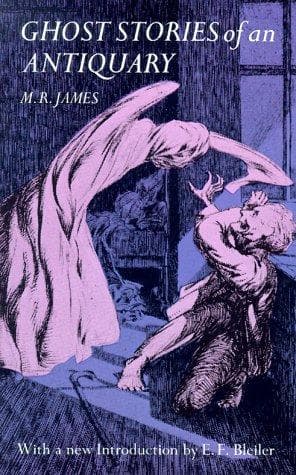
Ghost Stories of an AntiquaryJames, M. R. (Montague Rhodes)
General
Ghost Stories of an Antiquary
James, M. R. (Montague Rhodes)
Ghost stories, English; Horror tales, English; Short stories, English
Everyone who has travelled over Eastern England knows the smaller
country-houses with which it is studded—the rather dank little
buildings, usually in the Italian style, surrounded with parks of some
eighty to a hundred acres. For me they have always had a very strong
attraction: with the grey paling of split oak, the noble trees, the
meres with their reed-beds, and the line of distant woods. Then, I like
the pillared portico—perhaps stuck on to a red-brick Queen Anne house
which has been faced with stucco to bring it into line with the
“Grecian” taste of the end of the eighteenth century; the hall inside,
going up to the roof, which hall ought always to be provided with a
gallery and a small organ. I like the library, too, where you may find
anything from a Psalter of the thirteenth century to a Shakespeare
quarto. I like the pictures, of course; and perhaps most of all I like
fancying what life in such a house was when it was first built, and in
the piping times of landlords’ prosperity, and not least now, when, if
money is not so plentiful, taste is more varied and life quite as
interesting. I wish to have one of these houses, and enough money to
keep it together and entertain my friends in it modestly.
But this is a digression. I have to tell you of a curious series of
events which happened in such a house as I have tried to describe. It
is Castringham Hall in Suffolk. I think a good deal has been done to
the building since the period of my story, but the essential features I
have sketched are still there—Italian portico, square block of white
house, older inside than out, park with fringe of woods, and mere. The
one feature that marked out the house from a score of others is gone.
As you looked at it from the park, you saw on the right a great old
ash-tree growing within half a dozen yards of the wall, and almost or
quite touching the building with its branches. I suppose it had stood
there ever since Castringham ceased to be a fortified place, and since
the moat was filled in and the Elizabethan dwelling-house built. At any
rate, it had well-nigh attained its full dimensions in the year 1690.
In that year the district in which the Hall is situated was the scene
of a number of witch-trials. It will be long, I think, before we arrive
at a just estimate of the amount of solid reason—if there was any—which
lay at the root of the universal fear of witches in old times. Whether
the persons accused of this offence really did imagine that they were
possessed of unusual power of any kind; or whether they had the will at
least, if not the power, of doing mischief to their neighbours; or
whether all the confessions, of which there are so many, were extorted
by the mere cruelty of the witch-finders—these are questions which are
not, I fancy, yet solved. And the present narrative gives me pause. I
cannot altogether sweep it away as mere invention. The reader must
judge for himself.
Public-domain text, read in full here on John Shaqi.
Reviews
Reviews
No reviews yet
Be the first to share your thoughts on this work.
Join the Discussion
Join the discussion
Sign in to leave a comment or review.
Sign InorCreate an account