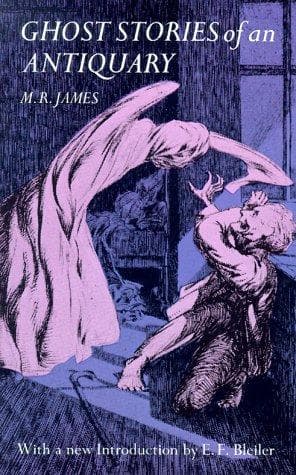
Ghost Stories of an AntiquaryJames, M. R. (Montague Rhodes)
General
Ghost Stories of an Antiquary
James, M. R. (Montague Rhodes)
Ghost stories, English; Horror tales, English; Short stories, English
Those who are interested in the details will find a statistical account
in a letter to the _Gentleman’s Magazine_ of 1772, which draws the
facts from the Baronet’s own papers. He put an end to it at last by a
very simple expedient, that of shutting up all his beasts in sheds at
night, and keeping no sheep in his park. For he had noticed that
nothing was ever attacked that spent the night indoors. After that the
disorder confined itself to wild birds, and beasts of chase. But as we
have no good account of the symptoms, and as all-night watching was
quite unproductive of any clue, I do not dwell on what the Suffolk
farmers called the “Castringham sickness”.
The second Sir Matthew died in 1735, as I said, and was duly succeeded
by his son, Sir Richard. It was in his time that the great family pew
was built out on the north side of the parish church. So large were the
Squire’s ideas that several of the graves on that unhallowed side of
the building had to be disturbed to satisfy his requirements. Among
them was that of Mrs Mothersole, the position of which was accurately
known, thanks to a note on a plan of the church and yard, both made by
Mr Crome.
A certain amount of interest was excited in the village when it was
known that the famous witch, who was still remembered by a few, was to
be exhumed. And the feeling of surprise, and indeed disquiet, was very
strong when it was found that, though her coffin was fairly sound and
unbroken, there was no trace whatever inside it of body, bones, or
dust. Indeed, it is a curious phenomenon, for at the time of her
burying no such things were dreamt of as resurrection-men, and it is
difficult to conceive any rational motive for stealing a body otherwise
than for the uses of the dissecting-room.
The incident revived for a time all the stories of witch-trials and of
the exploits of the witches, dormant for forty years, and Sir Richard’s
orders that the coffin should be burnt were thought by a good many to
be rather foolhardy, though they were duly carried out.
Sir Richard was a pestilent innovator, it is certain. Before his time
the Hall had been a fine block of the mellowest red brick; but Sir
Richard had travelled in Italy and become infected with the Italian
taste, and, having more money than his predecessors, he determined to
leave an Italian palace where he had found an English house. So stucco
and ashlar masked the brick; some indifferent Roman marbles were
planted about in the entrance-hall and gardens; a reproduction of the
Sibyl’s temple at Tivoli was erected on the opposite bank of the mere;
and Castringham took on an entirely new, and, I must say, a less
engaging, aspect. But it was much admired, and served as a model to a
good many of the neighbouring gentry in after-years.
Public-domain text, read in full here on John Shaqi.
Reviews
Reviews
No reviews yet
Be the first to share your thoughts on this work.
Join the Discussion
Join the discussion
Sign in to leave a comment or review.
Sign InorCreate an account