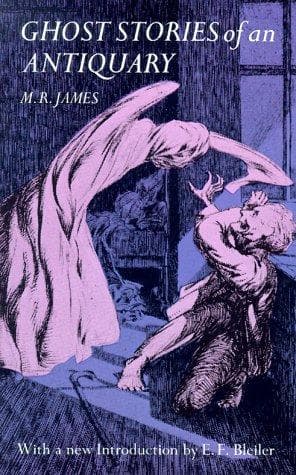
Ghost Stories of an AntiquaryJames, M. R. (Montague Rhodes)
General
Ghost Stories of an Antiquary
James, M. R. (Montague Rhodes)
Ghost stories, English; Horror tales, English; Short stories, English
On the day after his arrival Anderson attacked the Rigsarkiv of Viborg.
He was, as one might expect in Denmark, kindly received, and access to
all that he wished to see was made as easy for him as possible. The
documents laid before him were far more numerous and interesting than
he had at all anticipated. Besides official papers, there was a large
bundle of correspondence relating to Bishop Jörgen Friis, the last
Roman Catholic who held the see, and in these there cropped up many
amusing and what are called “intimate” details of private life and
individual character. There was much talk of a house owned by the
Bishop, but not inhabited by him, in the town. Its tenant was
apparently somewhat of a scandal and a stumbling-block to the reforming
party. He was a disgrace, they wrote, to the city; he practised secret
and wicked arts, and had sold his soul to the enemy. It was of a piece
with the gross corruption and superstition of the Babylonish Church
that such a viper and blood-sucking _Troldmand_ should be patronized
and harboured by the Bishop. The Bishop met these reproaches boldly; he
protested his own abhorrence of all such things as secret arts, and
required his antagonists to bring the matter before the proper court—of
course, the spiritual court—and sift it to the bottom. No one could be
more ready and willing than himself to condemn Mag Nicolas Francken if
the evidence showed him to have been guilty of any of the crimes
informally alleged against him.
Anderson had not time to do more than glance at the next letter of the
Protestant leader, Rasmus Nielsen, before the record office was closed
for the day, but he gathered its general tenor, which was to the effect
that Christian men were now no longer bound by the decisions of Bishops
of Rome, and that the Bishop’s Court was not, and could not be, a fit
or competent tribunal to judge so grave and weighty a cause.
On leaving the office, Mr Anderson was accompanied by the old gentleman
who presided over it, and, as they walked, the conversation very
naturally turned to the papers of which I have just been speaking.
Herr Scavenius, the Archivist of Viborg, though very well informed as
to the general run of the documents under his charge, was not a
specialist in those of the Reformation period. He was much interested
in what Anderson had to tell him about them. He looked forward with
great pleasure, he said, to seeing the publication in which Mr Anderson
spoke of embodying their contents. “This house of the Bishop Friis,” he
added, “it is a great puzzle to me where it can have stood. I have
studied carefully the topography of old Viborg, but it is most
unlucky—of the old terrier of the Bishop’s property which was made in
1560, and of which we have the greater part in the Arkiv, just the
piece which had the list of the town property is missing. Never mind.
Perhaps I shall some day succeed to find him.”
Public-domain text, read in full here on John Shaqi.
Reviews
Reviews
No reviews yet
Be the first to share your thoughts on this work.
Join the Discussion
Join the discussion
Sign in to leave a comment or review.
Sign InorCreate an account