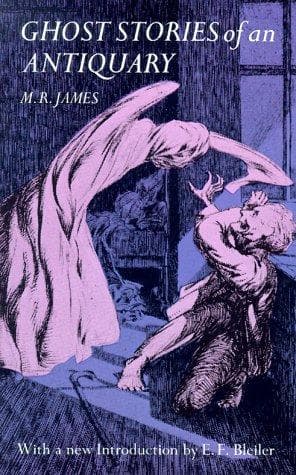
Ghost Stories of an AntiquaryJames, M. R. (Montague Rhodes)
General
Ghost Stories of an Antiquary
James, M. R. (Montague Rhodes)
Ghost stories, English; Horror tales, English; Short stories, English
He started to go down to breakfast. Rather late, but Number 13 was
later: here were his boots still outside his door—a gentleman’s boots.
So then Number 13 was a man, not a woman. Just then he caught sight of
the number on the door. It was 14. He thought he must have passed
Number 13 without noticing it. Three stupid mistakes in twelve hours
were too much for a methodical, accurate-minded man, so he turned back
to make sure. The next number to 14 was number 12, his own room. There
was no Number 13 at all.
After some minutes devoted to a careful consideration of everything he
had had to eat and drink during the last twenty-four hours, Anderson
decided to give the question up. If his eyes or his brain were giving
way he would have plenty of opportunities for ascertaining that fact;
if not, then he was evidently being treated to a very interesting
experience. In either case the development of events would certainly be
worth watching.
During the day he continued his examination of the episcopal
correspondence which I have already summarized. To his disappointment,
it was incomplete. Only one other letter could be found which referred
to the affair of Mag Nicolas Francken. It was from the Bishop Jörgen
Friis to Rasmus Nielsen. He said:
“Although we are not in the least degree inclined to assent to your
judgement concerning our court, and shall be prepared if need be to
withstand you to the uttermost in that behalf, yet forasmuch as our
trusty and well-beloved Mag Nicolas Francken, against whom you have
dared to allege certain false and malicious charges, hath been suddenly
removed from among us, it is apparent that the question for this time
falls. But forasmuch as you further allege that the Apostle and
Evangelist St John in his heavenly Apocalypse describes the Holy Roman
Church under the guise and symbol of the Scarlet Woman, be it known to
you,” etc.
Search as he might, Anderson could find no sequel to this letter nor
any clue to the cause or manner of the “removal” of the _casus belli_.
He could only suppose that Francken had died suddenly; and as there
were only two days between the date of Nielsen’s last letter—when
Francken was evidently still in being—and that of the Bishop’s letter,
the death must have been completely unexpected.
In the afternoon he paid a short visit to Hald, and took his tea at
Baekkelund; nor could he notice, though he was in a somewhat nervous
frame of mind, that there was any indication of such a failure of eye
or brain as his experiences of the morning had led him to fear.
At supper he found himself next to the landlord.
“What,” he asked him, after some indifferent conversation, “is the
reason why in most of the hotels one visits in this country the number
thirteen is left out of the list of rooms? I see you have none here.”
The landlord seemed amused.
Public-domain text, read in full here on John Shaqi.
Reviews
Reviews
No reviews yet
Be the first to share your thoughts on this work.
Join the Discussion
Join the discussion
Sign in to leave a comment or review.
Sign InorCreate an account