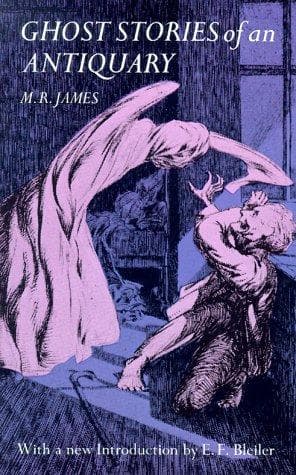
Ghost Stories of an AntiquaryJames, M. R. (Montague Rhodes)
General
Ghost Stories of an Antiquary
James, M. R. (Montague Rhodes)
Ghost stories, English; Horror tales, English; Short stories, English
You will naturally suppose that a skeleton—say that of Mag Nicolas
Francken—was discovered. That was not so. What they did find lying
between the beams which supported the flooring was a small copper box.
In it was a neatly-folded vellum document, with about twenty lines of
writing. Both Anderson and Jensen (who proved to be something of a
palæographer) were much excited by this discovery, which promised to
afford the key to these extraordinary phenomena.
I possess a copy of an astrological work which I have never read. It
has, by way of frontispiece, a woodcut by Hans Sebald Beham,
representing a number of sages seated round a table. This detail may
enable connoisseurs to identify the book. I cannot myself recollect its
title, and it is not at this moment within reach; but the fly-leaves of
it are covered with writing, and, during the ten years in which I have
owned the volume, I have not been able to determine which way up this
writing ought to be read, much less in what language it is. Not
dissimilar was the position of Anderson and Jensen after the protracted
examination to which they submitted the document in the copper box.
After two days’ contemplation of it, Jensen, who was the bolder spirit
of the two, hazarded the conjecture that the language was either Latin
or Old Danish.
Anderson ventured upon no surmises, and was very willing to surrender
the box and the parchment to the Historical Society of Viborg to be
placed in their museum.
I had the whole story from him a few months later, as we sat in a wood
near Upsala, after a visit to the library there, where we—or, rather,
I—had laughed over the contract by which Daniel Salthenius (in later
life Professor of Hebrew at Königsberg) sold himself to Satan. Anderson
was not really amused.
“Young idiot!” he said, meaning Salthenius, who was only an
undergraduate when he committed that indiscretion, “how did he know
what company he was courting?”
And when I suggested the usual considerations he only grunted. That
same afternoon he told me what you have read; but he refused to draw
any inferences from it, and to assent to any that I drew for him.
COUNT MAGNUS
By what means the papers out of which I have made a connected story
came into my hands is the last point which the reader will learn from
these pages. But it is necessary to prefix to my extracts from them a
statement of the form in which I possess them.
Public-domain text, read in full here on John Shaqi.
Reviews
Reviews
No reviews yet
Be the first to share your thoughts on this work.
Join the Discussion
Join the discussion
Sign in to leave a comment or review.
Sign InorCreate an account