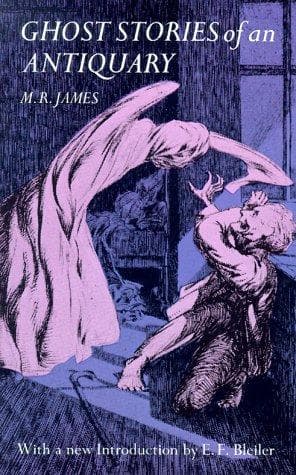
Ghost Stories of an AntiquaryJames, M. R. (Montague Rhodes)
General
Ghost Stories of an Antiquary
James, M. R. (Montague Rhodes)
Ghost stories, English; Horror tales, English; Short stories, English
Parkins had, in fact, very little time for dressing. When he met the
Colonel at dinner, Peace—or as much of her as that gentleman could
manage—reigned once more in the military bosom; nor was she put to
flight in the hours of bridge that followed dinner, for Parkins was a
more than respectable player. When, therefore, he retired towards
twelve o’clock, he felt that he had spent his evening in quite a
satisfactory way, and that, even for so long as a fortnight or three
weeks, life at the Globe would be supportable under similar
conditions—“especially,” thought he, “if I go on improving my game.”
As he went along the passages he met the boots of the Globe, who
stopped and said:
“Beg your pardon, sir, but as I was a-brushing your coat just now there
was somethink fell out of the pocket. I put it on your chest of
drawers, sir, in your room, sir—a piece of a pipe or somethink of that,
sir. Thank you, sir. You’ll find it on your chest of drawers, sir—yes,
sir. Good night, sir.”
The speech served to remind Parkins of his little discovery of that
afternoon. It was with some considerable curiosity that he turned it
over by the light of his candles. It was of bronze, he now saw, and was
shaped very much after the manner of the modern dog-whistle; in fact it
was—yes, certainly it was—actually no more nor less than a whistle. He
put it to his lips, but it was quite full of a fine, caked-up sand or
earth, which would not yield to knocking, but must be loosened with a
knife. Tidy as ever in his habits, Parkins cleared out the earth on to
a piece of paper, and took the latter to the window to empty it out.
The night was clear and bright, as he saw when he had opened the
casement, and he stopped for an instant to look at the sea and note a
belated wanderer stationed on the shore in front of the inn. Then he
shut the window, a little surprised at the late hours people kept at
Burnstow, and took his whistle to the light again. Why, surely there
were marks on it, and not merely marks, but letters! A very little
rubbing rendered the deeply-cut inscription quite legible, but the
Professor had to confess, after some earnest thought, that the meaning
of it was as obscure to him as the writing on the wall to Belshazzar.
There were legends both on the front and on the back of the whistle.
The one read thus:
FLA FUR BIS FLE
The other:
QUIS EST ISTE QUI VENIT
“I ought to be able to make it out,” he thought; “but I suppose I am a
little rusty in my Latin. When I come to think of it, I don’t believe I
even know the word for a whistle. The long one does seem simple enough.
It ought to mean, ‘Who is this who is coming?’ Well, the best way to
find out is evidently to whistle for him.”
Public-domain text, read in full here on John Shaqi.
Reviews
Reviews
No reviews yet
Be the first to share your thoughts on this work.
Elsewhere in the archive
Join the Discussion
Join the discussion
Sign in to leave a comment or review.
Sign InorCreate an account