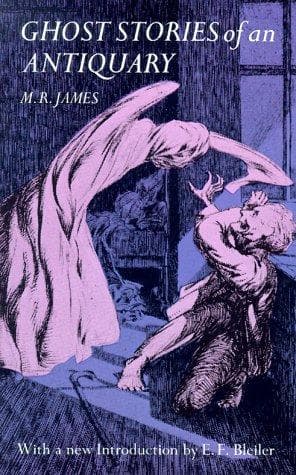
Ghost Stories of an AntiquaryJames, M. R. (Montague Rhodes)
General
Ghost Stories of an Antiquary
James, M. R. (Montague Rhodes)
Ghost stories, English; Horror tales, English; Short stories, English
He blew tentatively and stopped suddenly, startled and yet pleased at
the note he had elicited. It had a quality of infinite distance in it,
and, soft as it was, he somehow felt it must be audible for miles
round. It was a sound, too, that seemed to have the power (which many
scents possess) of forming pictures in the brain. He saw quite clearly
for a moment a vision of a wide, dark expanse at night, with a fresh
wind blowing, and in the midst a lonely figure—how employed, he could
not tell. Perhaps he would have seen more had not the picture been
broken by the sudden surge of a gust of wind against his casement, so
sudden that it made him look up, just in time to see the white glint of
a seabird’s wing somewhere outside the dark panes.
The sound of the whistle had so fascinated him that he could not help
trying it once more, this time more boldly. The note was little, if at
all, louder than before, and repetition broke the illusion—no picture
followed, as he had half hoped it might. ‘But what is this? Goodness!
what force the wind can get up in a few minutes! What a tremendous
gust! There! I knew that window-fastening was no use! Ah! I thought
so—both candles out. It is enough to tear the room to pieces.’
The first thing was to get the window shut. While you might count
twenty Parkins was struggling with the small casement, and felt almost
as if he were pushing back a sturdy burglar, so strong was the
pressure. It slackened all at once, and the window banged to and
latched itself. Now to relight the candles and see what damage, if any,
had been done. No, nothing seemed amiss; no glass even was broken in
the casement. But the noise had evidently roused at least one member of
the household: the Colonel was to be heard stumping in his stockinged
feet on the floor above, and growling.
Quickly as it had risen, the wind did not fall at once. On it went,
moaning and rushing past the house, at times rising to a cry so
desolate that, as Parkins disinterestedly said, it might have made
fanciful people feel quite uncomfortable; even the unimaginative, he
thought after a quarter of an hour, might be happier without it.
Whether it was the wind, or the excitement of golf, or of the
researches in the preceptory that kept Parkins awake, he was not sure.
Awake he remained, in any case, long enough to fancy (as I am afraid I
often do myself under such conditions) that he was the victim of all
manner of fatal disorders: he would lie counting the beats of his
heart, convinced that it was going to stop work every moment, and would
entertain grave suspicions of his lungs, brain, liver, etc.—suspicions
which he was sure would be dispelled by the return of daylight, but
which until then refused to be put aside. He found a little vicarious
comfort in the idea that someone else was in the same boat. A near
neighbour (in the darkness it was not easy to tell his direction) was
tossing and rustling in his bed, too.
Public-domain text, read in full here on John Shaqi.
Reviews
Reviews
No reviews yet
Be the first to share your thoughts on this work.
Elsewhere in the archive
Join the Discussion
Join the discussion
Sign in to leave a comment or review.
Sign InorCreate an account