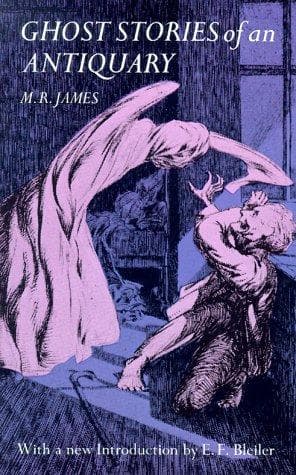
Ghost Stories of an AntiquaryJames, M. R. (Montague Rhodes)
General
Ghost Stories of an Antiquary
James, M. R. (Montague Rhodes)
Ghost stories, English; Horror tales, English; Short stories, English
I am glad to be able to report that he succeeded so far in this
enterprise that the Colonel, who had been rather repining at the
prospect of a second day’s play in his company, became quite chatty as
the morning advanced; and his voice boomed out over the flats, as
certain also of our own minor poets have said, “like some great bourdon
in a minster tower”.
“Extraordinary wind, that, we had last night,” he said. “In my old home
we should have said someone had been whistling for it.”
“Should you, indeed!” said Parkins. “Is there a superstition of that
kind still current in your part of the country?”
“I don’t know about superstition,” said the Colonel. “They believe in
it all over Denmark and Norway, as well as on the Yorkshire coast; and
my experience is, mind you, that there’s generally something at the
bottom of what these country-folk hold to, and have held to for
generations. But it’s your drive” (or whatever it might have been: the
golfing reader will have to imagine appropriate digressions at the
proper intervals).
When conversation was resumed, Parkins said, with a slight hesitancy:
“A propos of what you were saying just now, Colonel, I think I ought to
tell you that my own views on such subjects are very strong. I am, in
fact, a convinced disbeliever in what is called the ‘supernatural’.”
“What!” said the Colonel, “do you mean to tell me you don’t believe in
second-sight, or ghosts, or anything of that kind?”
“In nothing whatever of that kind,” returned Parkins firmly.
“Well,” said the Colonel, “but it appears to me at that rate, sir, that
you must be little better than a Sadducee.”
Parkins was on the point of answering that, in his opinion, the
Sadducees were the most sensible persons he had ever read of in the Old
Testament; but, feeling some doubt as to whether much mention of them
was to be found in that work, he preferred to laugh the accusation off.
“Perhaps I am,” he said; “but—Here, give me my cleek, boy!—Excuse me
one moment, Colonel.” A short interval. “Now, as to whistling for the
wind, let me give you my theory about it. The laws which govern winds
are really not at all perfectly known—to fisherfolk and such, of
course, not known at all. A man or woman of eccentric habits, perhaps,
or a stranger, is seen repeatedly on the beach at some unusual hour,
and is heard whistling. Soon afterwards a violent wind rises; a man who
could read the sky perfectly or who possessed a barometer could have
foretold that it would. The simple people of a fishing-village have no
barometers, and only a few rough rules for prophesying weather. What
more natural than that the eccentric personage I postulated should be
regarded as having raised the wind, or that he or she should clutch
eagerly at the reputation of being able to do so? Now, take last
night’s wind: as it happens, I myself was whistling. I blew a whistle
twice, and the wind seemed to come absolutely in answer to my call. If
anyone had seen me—”
Public-domain text, read in full here on John Shaqi.
Reviews
Reviews
No reviews yet
Be the first to share your thoughts on this work.
Elsewhere in the archive
Join the Discussion
Join the discussion
Sign in to leave a comment or review.
Sign InorCreate an account