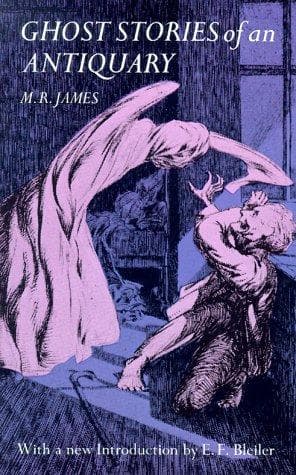
Ghost Stories of an AntiquaryJames, M. R. (Montague Rhodes)
General
Ghost Stories of an Antiquary
James, M. R. (Montague Rhodes)
Ghost stories, English; Horror tales, English; Short stories, English
The audience had been a little restive under this harangue, and Parkins
had, I fear, fallen somewhat into the tone of a lecturer; but at the
last sentence the Colonel stopped.
“Whistling, were you?” he said. “And what sort of whistle did you use?
Play this stroke first.” Interval.
“About that whistle you were asking, Colonel. It’s rather a curious
one. I have it in my—No; I see I’ve left it in my room. As a matter of
fact, I found it yesterday.”
And then Parkins narrated the manner of his discovery of the whistle,
upon hearing which the Colonel grunted, and opined that, in Parkins’s
place, he should himself be careful about using a thing that had
belonged to a set of Papists, of whom, speaking generally, it might be
affirmed that you never knew what they might not have been up to. From
this topic he diverged to the enormities of the Vicar, who had given
notice on the previous Sunday that Friday would be the Feast of St
Thomas the Apostle, and that there would be service at eleven o’clock
in the church. This and other similar proceedings constituted in the
Colonel’s view a strong presumption that the Vicar was a concealed
Papist, if not a Jesuit; and Parkins, who could not very readily follow
the Colonel in this region, did not disagree with him. In fact, they
got on so well together in the morning that there was no talk on either
side of their separating after lunch.
Both continued to play well during the afternoon, or, at least, well
enough to make them forget everything else until the light began to
fail them. Not until then did Parkins remember that he had meant to do
some more investigating at the preceptory; but it was of no great
importance, he reflected. One day was as good as another; he might as
well go home with the Colonel.
As they turned the corner of the house, the Colonel was almost knocked
down by a boy who rushed into him at the very top of his speed, and
then, instead of running away, remained hanging on to him and panting.
The first words of the warrior were naturally those of reproof and
objurgation, but he very quickly discerned that the boy was almost
speechless with fright. Inquiries were useless at first. When the boy
got his breath he began to howl, and still clung to the Colonel’s legs.
He was at last detached, but continued to howl.
“What in the world _is_ the matter with you? What have you been up to?
What have you seen?” said the two men.
“Ow, I seen it wive at me out of the winder,” wailed the boy, “and I
don’t like it.”
“What window?” said the irritated Colonel. “Come, pull yourself
together, my boy.”
“The front winder it was, at the ’otel,” said the boy.
Public-domain text, read in full here on John Shaqi.
Reviews
Reviews
No reviews yet
Be the first to share your thoughts on this work.
Elsewhere in the archive
Join the Discussion
Join the discussion
Sign in to leave a comment or review.
Sign InorCreate an account