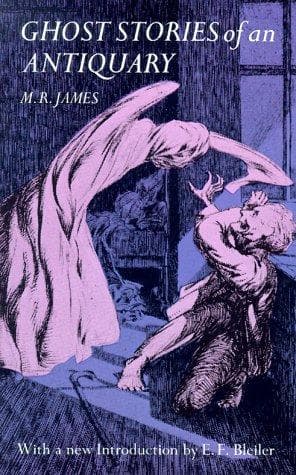
Ghost Stories of an AntiquaryJames, M. R. (Montague Rhodes)
General
Ghost Stories of an Antiquary
James, M. R. (Montague Rhodes)
Ghost stories, English; Horror tales, English; Short stories, English
At this point Parkins was in favour of sending the boy home, but the
Colonel refused; he wanted to get to the bottom of it, he said; it was
most dangerous to give a boy such a fright as this one had had, and if
it turned out that people had been playing jokes, they should suffer
for it in some way. And by a series of questions he made out this
story: The boy had been playing about on the grass in front of the
Globe with some others; then they had gone home to their teas, and he
was just going, when he happened to look up at the front winder and see
it a-wiving at him. _It_ seemed to be a figure of some sort, in white
as far as he knew—couldn’t see its face; but it wived at him, and it
warn’t a right thing—not to say not a right person. Was there a light
in the room? No, he didn’t think to look if there was a light. Which
was the window? Was it the top one or the second one? The seckind one
it was—the big winder what got two little uns at the sides.
“Very well, my boy,” said the Colonel, after a few more questions. “You
run away home now. I expect it was some person trying to give you a
start. Another time, like a brave English boy, you just throw a
stone—well, no, not that exactly, but you go and speak to the waiter,
or to Mr Simpson, the landlord, and—yes—and say that I advised you to
do so.”
The boy’s face expressed some of the doubt he felt as to the likelihood
of Mr Simpson’s lending a favourable ear to his complaint, but the
Colonel did not appear to perceive this, and went on:
“And here’s a sixpence—no, I see it’s a shilling—and you be off home,
and don’t think any more about it.”
The youth hurried off with agitated thanks, and the Colonel and Parkins
went round to the front of the Globe and reconnoitred. There was only
one window answering to the description they had been hearing.
“Well, that’s curious,” said Parkins; “it’s evidently my window the lad
was talking about. Will you come up for a moment, Colonel Wilson? We
ought to be able to see if anyone has been taking liberties in my
room.”
They were soon in the passage, and Parkins made as if to open the door.
Then he stopped and felt in his pockets.
“This is more serious than I thought,” was his next remark. “I remember
now that before I started this morning I locked the door. It is locked
now, and, what is more, here is the key.” And he held it up. “Now,” he
went on, “if the servants are in the habit of going into one’s room
during the day when one is away, I can only say that—well, that I don’t
approve of it at all.” Conscious of a somewhat weak climax, he busied
himself in opening the door (which was indeed locked) and in lighting
candles. “No,” he said, “nothing seems disturbed.”
“Except your bed,” put in the Colonel.
“Excuse me, that isn’t my bed,” said Parkins. “I don’t use that one.
But it does look as if someone had been playing tricks with it.”
It certainly did: the clothes were bundled up and twisted together in a
most tortuous confusion. Parkins pondered.
Public-domain text, read in full here on John Shaqi.
Reviews
Reviews
No reviews yet
Be the first to share your thoughts on this work.
Elsewhere in the archive
Join the Discussion
Join the discussion
Sign in to leave a comment or review.
Sign InorCreate an account