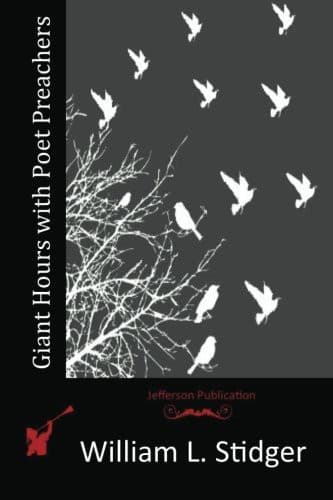
Giant Hours with Poet PreachersStidger, William L. (William Le Roy)
Religion
Giant Hours with Poet Preachers
Stidger, William L. (William Le Roy)
American poetry -- 20th century -- History and criticism; English poetry -- 20th century -- History and criticism
There was the bed on which Miller lay for months writing many of his
greatest poems, including the famous "Columbus." There was his
picturesque sombrero, still hanging where he had put it last on the
post of the great bed. His pen was at hand; his writing pad, his chair,
his great fur coat, his handkerchief of many colors which in life he
always wore about his neck; his great heavy, high-topped boots. And
it was sunset.
Then Mrs. Miller began to read. As the slanting rays of as crimson a
sunset as God ever painted were falling through the great cross of pine
trees, Mrs. Miller's dramatic, sweet, sympathetic voice interpreted his
poems for us. I sat on the bed from which Miller had, just a few months
previous to that, heard the great call. The others sat in his great
rockers. Mrs. Miller stood as she read. I am sure that "Columbus" will
never be lifted into the sublime as it was when she read it that late
May afternoon, with its famous, and thrilling phrase "Sail on! Sail on!
And on! And on!"
A STUDY OF HOME
I had thought before hearing Mrs. Miller read "The Greatest Battle that
Ever was Fought" that I had caught all the subtle meanings of it, but
after her reading that great tribute to womanhood I knew that I had
never dreamed the half of its inner meaning:
"The greatest battle that ever was fought---
Shall I tell you where and when?
On the maps of the world you will find it not:
It was fought by the Mothers of Men.
"Not with cannon or battle shot,
With sword or nobler pen;
Not with eloquent word or thought
From the wonderful minds of men;
"But deep in a walled up woman's heart;
A woman that would not yield;
But bravely and patiently bore her part;
Lo! there is that battlefield.
"No marshaling troops, no bivouac song,
No banner to gleam and wave;
But Oh these battles they last so long--From
babyhood to the grave!
"But faithful still as a bridge of stars
She fights in her walled up town;
Fights on, and on, in the endless wars;
Then silent, unseen goes down I
"Ho! ye with banners and battle shot,
With soldiers to shout and praise,
I tell you the kingliest victories fought
Are fought in these silent ways."
Then, as if to give us another illustration of her great poet husband's
home love, she read for us "Juanita":
"You will come, my bird, Bonita?
Come, for I by steep and stone,
Have built such nest, for you, Juanita,
As not eagle bird hath known.
. . . . . . . . .
All is finished! Roads of flowers
Wait your loyal little feet.
All completed? Nay, the hours
Till you come are incomplete!"
Who that hath the blessing of little children will not understand this
waiting, yearning love of Miller for his ten-year-old girl, who was
at that time in New York with her mother waiting until "The Heights"
should be finished? Who does not understand how incomplete the hours
were until she came?
Public-domain text, read in full here on John Shaqi.
Reviews
Reviews
No reviews yet
Be the first to share your thoughts on this work.
Join the Discussion
Join the discussion
Sign in to leave a comment or review.
Sign InorCreate an account