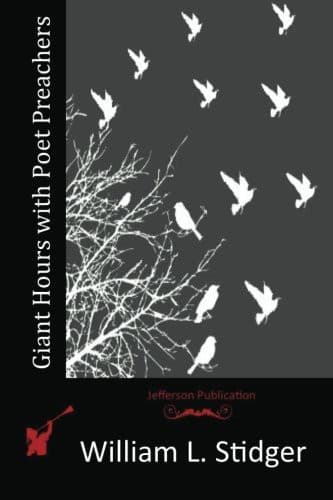
Giant Hours with Poet PreachersStidger, William L. (William Le Roy)
Religion
Giant Hours with Poet Preachers
Stidger, William L. (William Le Roy)
American poetry -- 20th century -- History and criticism; English poetry -- 20th century -- History and criticism
ALAN SEEGER
[Footnote: The poetical selections appearing in this chapter are used
by permission, and are taken from poems by Alan Seeger. Published by
Charles Scribner's Sons, New York. ]
POET OF YOUTH, BEAUTY, FAME, JOY, LOVE, DEATH, AND GOD
Rupert Brooke and Alan Seeger--so shall their names be linked together
forever by those who love poetry. In the first place, they were much
alike: buoyant, young; loving life, living life; and both dying for the
great cause of humanity in the world's greatest war. Brooke the
Englishman; Seeger the American; so are they linked. Both were but lads
in their twenties; both vivid as lightning and as warm as summer
sunshine in their personalities; both truly great poets, who had, even
in the short time they lived, run a wide gamut of poetic expression.
I am not saying that either Brooke or Seeger may be called a Christian
poet; nor am I saying that they may not be called that. This war in
which they have given their lives will make a vast difference in the
definition of what a Christian is. I can detect no orthodox Christian
message in either of their dreamings, but I do find in both poets a
clean, high moral message, and therefore give them place in this pulpit
of the poets.
The wide range of this young American's writing astonishes the reader.
He died very young: while the morning sun was just lifting its head
above the eastern horizon of life; while the heavens were still
crimson, and gold, and rose, and fire. What he might have written in
the steady white heat of noontime and in life's glorious afternoon of
experience, and in its subtle charm of "sunset and the evening star,"
one can only guess. But while he lived he lived; and, living, wrote. He
dipped his pen in that same gold and fire of the only part of life he
knew, its daybreak, and wrote. No wonder his writing was warm; no
wonder he wrote of Youth, Beauty, Fame, Joy, Love, Death, and God.
THE SONG OF YOUTH
Nor Byron, nor Shelley, nor Keats, nor Swinburne, nor Brooke, nor any
other poet ever sounded the heights and depths and glory of Youth as
did Seeger. He sang it as he breathed it and lived it, and just as
naturally. His singing of it was as rhythmic as breathing, and as sweet
as the first song of an oriole in springtime. In his fifth sonnet, a
form in which he loved to write and of which he was a master, he sings
youth in terms "almost divine":
"Phantoms of bliss that beckon and recede--,
Thy strange allurements, City that I love,
Maze of romance, where I have followed too
The dream Youth treasures of its dearest need
And stars beyond thy towers bring tidings of."
Poems by Alan Seeger.
Public-domain text, read in full here on John Shaqi.
Reviews
Reviews
No reviews yet
Be the first to share your thoughts on this work.
Join the Discussion
Join the discussion
Sign in to leave a comment or review.
Sign InorCreate an account