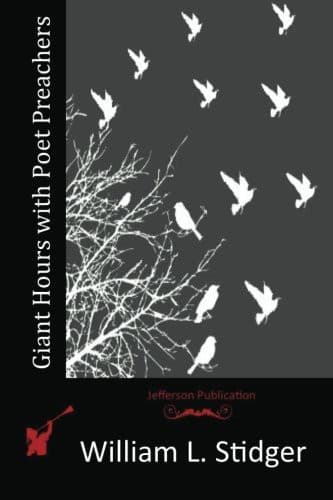
Giant Hours with Poet PreachersStidger, William L. (William Le Roy)
Religion
Giant Hours with Poet Preachers
Stidger, William L. (William Le Roy)
American poetry -- 20th century -- History and criticism; English poetry -- 20th century -- History and criticism
If one wants to find the tenderest, most completely sympathetic study
of childhood, one that finds echo not only in the heart of the
grown-up, but in the heart of children the world over, he must this day
go to Alfred Noyes. If you want proof of this, read "The Forest of Wild
Thyme" or "The Flower of Old Japan" to your children and watch them sit
with open mouths and open hearts to hear these wonder fairy tales. And,
further, if you are too grown-up to want to read Noyes for his complete
sympathy with childhood, more universal even than our beloved Riley;
and you want a poet that challenges you to a more vigorous manhood, a
poet who calls man to his highest and deepest virility, read Noyes. Or,
if you happen to need a clearer, firmer insight into the man of Galilee
and Calvary, read Noyes; and, finally, if you want firmer, more
rocklike foundations to plant your faith in God upon, read Noyes, for
herein one finds all of these. From childhood to Godhood is, indeed,
a wide range for a poet to take, and yet they are akin.
As another poet has said, none less than Edwin Markham, "Know man and
you will know the deep of God." And as Noyes himself says in the
introduction to "The Forest of Wild Thyme":
"Husband, there was a happy day,
Long ago in love's young May,
When, with a wild-flower in your hand
You echoed that dead poet's cry--
'Little flower, but if I could understand!'
And you saw it had roots in the depth of the sky,
And there in that smallest bud lay furled
The secret and meaning of all the world."
Collected Poems by Alfred Noyes.
And when we know that the mother was talking about "Little Peterkin,"
their lost baby, we know that she meant that in a little child there
lay furled "The secret and meaning of all the world."
And so, beginning with childhood, through those intermediate steps of
manhood and Christhood, with Noyes leading us, as he literally leads
the little tots through the mysteries of Old Japan and the Wild Thyme,
let us go from tree to tree, and flower to flower, and hope to hope,
and pain to pain, up to God, from whence we came. It is a clear sweet
pathway that he leads us.
CHILDHOOD AND ITS GLORY
Noyes assumes something that we all know for truth: that "Grown-ups do
not understand" childhood. But after reading this sweet poet we know
that he does understand; and we thank God for him. In Part II of "The
Forest of Wild Thyme" one sees this clearly.
"O, grown-ups cannot understand,
And grown-ups never will,
How short's the way to fairyland
Across the purple hill:
They smile: their smile is very bland,
Their eyes are wise and chill;
And yet--at just a child's command--
The world's an Eden still."
Collected Poems by Alfred Noyes.
Public-domain text, read in full here on John Shaqi.
Reviews
Reviews
No reviews yet
Be the first to share your thoughts on this work.
Join the Discussion
Join the discussion
Sign in to leave a comment or review.
Sign InorCreate an account