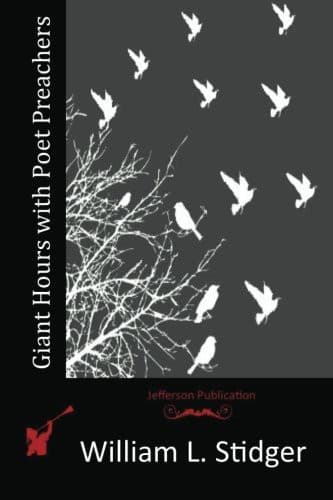
Giant Hours with Poet PreachersStidger, William L. (William Le Roy)
Religion
Giant Hours with Poet Preachers
Stidger, William L. (William Le Roy)
American poetry -- 20th century -- History and criticism; English poetry -- 20th century -- History and criticism
"Mine be a handful of ashes, a mouthful of mould.
Of the maimed, of the halt and the blind in the rain and the cold--
Of these shall my songs be fashioned, my tales be told. Amen."
Salt Water Poems and Ballads.
And it is a most fascinating story to see him climb from his boyhood,
purely social, sympathetic interest in the outcast to that higher, that
highest social consciousness, vitalized with religion. Here, seems it
to me, that those who possess true social consciousness must come at
last if they do their most effective work for the social regeneration
of the world. Many have tremendous social consciousness, but no Christ.
Christ himself is the very pulse beat of the social regeneration.
Without him it must fail.
One feels, even here in his youth poems, however, a promise of that
deeper Masefield that later finds his soul in "The Everlasting Mercy."
2. _Faith in Immortality_
In "Rest Her Soul," these haunting lines with that expression of a deep
faith found in "All that dies of her," we find a ray of light, which
slants through a small window of the man that is to be:
"On the black velvet covering her eyes
Let the dull earth be thrown;
Her's is the mightier silence of the skies,
And long, quiet rest alone.
Over the pure, dark, wistful eyes of her,
O'er all the human, all that dies of her,
Gently let flowers be strown."
Salt Water Poems and Ballads.
But most of these ballads, as their title suggests, are nothing more
than the very sea foam of which they speak, and whose tale they tell;
as compared with that later, deeper verse of Christian hope and
regeneration.
And then pass those ten years; ten years following the period of "The
Salt Water Ballads"; and ten years following the time when he was a
"bar-boy" in New York; ten years in which he climbs from a simple
"social consciousness" to a social consciousness that has the heart
beat of Christ in its every line. The poems he writes in this period
are all of the Christ. "Good Friday," perhaps the strongest poem
dealing with this great day in Christ's life, is full of a close
knowledge of the spirit of the Man of Galilee. But it is in "The
Everlasting Mercy" and not "The Story of a Round House" that we find
Masefield at his big best, battering at the very doors of eternity with
the fist of a giant and the tender love of a woman, and the plea of a
penitent sinner.
Something had happened to Masefield in those ten years. A man's entire
life had been revolutionized; and his poetry with it. He still feels
the want and need of the world, and the social injustice; but he has
found the cure. In a word, he has been converted. I do not care whether
or no Masefield means to tell his own story in "The Everlasting Mercy,"
but I do know that he tells, in spite of himself, a story that fits
curiously into, and marvelously explains, the strange revolution and
change in his own life from "Salt Water Ballads" to "Good Friday."
Public-domain text, read in full here on John Shaqi.
Reviews
Reviews
No reviews yet
Be the first to share your thoughts on this work.
Join the Discussion
Join the discussion
Sign in to leave a comment or review.
Sign InorCreate an account