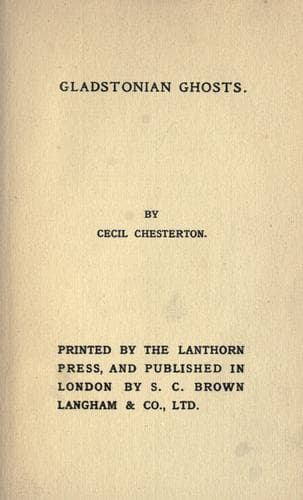
English essays -- 20th century; Great Britain -- Politics and government -- 1901-1910
Now it inevitably follows that there is not and cannot be any kind of
objection from his point of view to a protective tariff on grounds
of principle. The theoretic objection which used to be urged against
such a tariff was founded on the assumption that Adam Smith, Bastiat
and others had demonstrated the futility and peril of all legislative
interference with commerce. Cobden put the whole case as he and his
party saw it in one phrase of one of his ablest speeches, when he
declared that you could not by legislation add anything to the wealth
of a nation. That is a doctrine which no one (save perhaps Mr. Auberon
Herbert) now holds; which no one who approves for instance of any kind
of factory legislation can possibly hold. And that doctrine once fairly
out of the way, the question becomes simply one of expediency and the
balance of utilities.
But, when we come to the balancing, another point of divergence
instantly arises. The Socialists’ conception of utilities differs in
essence from that of Free Traders and Protectionists alike. For Mr.
Chamberlain, for Mr. Morley, for the Tariff Reform League and for the
Cobden Club, the aim of commercial statesmanship is simply and solely
to increase the aggregate commercial wealth of the country. But this is
by no means what the Socialist is mainly concerned about. His object
is not so much to increase the sum total of such wealth as to secure
its better distribution and more socially profitable use. He sees that
the economic struggle between nations is by comparison a matter of
surface fluctuations, while the economic struggle between classes is an
enduring and essential feature of our social system. And whether or no
he likes the old Marxian phrase “Class War,” he is bound to recognise
the existence of a class antagonism cutting right across society as a
fact without the understanding of which the structure of capitalist
civilisation is unintelligible.
Public-domain text, read in full here on John Shaqi.
Reviews
Reviews
No reviews yet
Be the first to share your thoughts on this work.
Join the Discussion
Join the discussion
Sign in to leave a comment or review.
Sign InorCreate an account