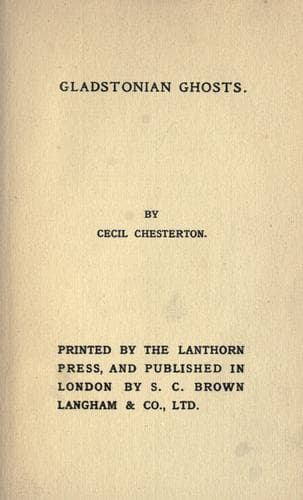
English essays -- 20th century; Great Britain -- Politics and government -- 1901-1910
It is a common taunt in the mouths of Tariff Reformers just now that
Cobden and Bright opposed the Factory Acts; and Liberals, driven
into a corner on the subject, generally affect to regard this as an
unfortunate and unaccountable lapse from grace on the part of the two
Free Trade Apostles. Of course it was nothing of the sort: it was
the only possible line for them to take as honest men and consistent
political thinkers. The matter of the Factory Acts does not stand
alone: state education, when first proposed was met with Radical
opposition of a very similar kind. If anyone will look through the
speeches of the opponents of the early Factory Bills he will find that
they were attacked, just as the present government’s Education Bill
was attacked, not as revolutionary but as reactionary measures. They
were constantly compared to the Sumptuary Laws and to the statutes
regulating the position of apprentices which figure in mediæval
legislation. And the comparison is a perfectly fair one. Cobden and
Bright were fundamentally _right_ in their contention that Factory
Acts were contrary to the first principles of Liberalism. Such acts
were only passed, because the application of Liberal principles to
the questions involved had resulted in a welter of brutality, child
torture and racial deterioration, so horrible that no decently humane
man, no reasonable enlightened citizen could think of Lancashire and
its cotton trade without a shudder. When the Sovereign gave her assent
to the first effective Factory Bill she passed a prophetic sentence of
death on Liberalism and the Liberal Party.
Doubtless the execution of the sentence has been long deferred and
may yet be deferred longer. But the backbone had been taken out of
Liberalism as soon as that concession had been made. It could not claim
any longer to have a coherent or intelligible political philosophy.
For the arguments used by the Manchester School against import duties
were precisely the same as those used against factory legislation.
The two propositions were based upon the same axioms and postulates;
if one was wrong, why not the other? And if the worship of “doing as
one likes” were unsound in the region of economics what reason was
there for supposing it to be sound in the region of politics? If Free
Contract were an untenable foundation for society, what became of Free
Trade? And, if Free Trade were to go, might not the demand for a Free
Church have to follow? The fortress of Liberalism still looked imposing
enough, but the foundations were sapped and there were ominous cracks
and fissures in the walls.
Public-domain text, read in full here on John Shaqi.
Reviews
Reviews
No reviews yet
Be the first to share your thoughts on this work.
Join the Discussion
Join the discussion
Sign in to leave a comment or review.
Sign InorCreate an account