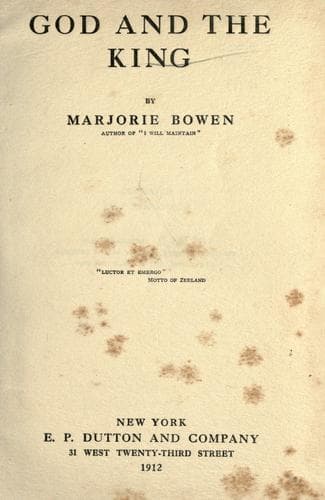
Great Britain -- History -- Revolution of 1688 -- Fiction; James II, King of England, 1633-1701 -- Fiction
He had honestly and justly tried to satisfy the English, but had met
with utter failure. They reproached—reviled him, complained, and loudly
voiced their dissatisfaction; he had not pleased one of those who had
placed him on the throne. The chaotic state of the Government might, to
a superficial observer, appear to give some warrant for their
discontent; but, as the King cynically observed to himself, they were
incapable of even suggesting a remedy for the ills they so decried; he
did everything, and Whig and Tory alike agreed in putting all burdens on
his shoulders, then in blaming his administration.
In the crisis of ’88 their action had been oblique. They had shifted
the almost intolerable confusion of affairs into his hands, then stood
back to watch and criticise, while he, who had already the business of
half Europe on his mind, made what order he could out of jarring chaos.
His health had broken under the strain; even his friends noticed a new
languor in him, which the English were quick to dub sloth. Deprived of
his one recreation of hunting—for which he had no time—hardly able to
endure the stenches and smoke of London, his reserved temper taxed
almost beyond bearing by the incessant, unreasonable, shortsighted
quarrelling by which he was surrounded, he felt his strength slipping
like water through his hands.
His popularity had gone as he had predicted it would. The Jacobites
were already a tremendously strong party, and his own ministers were
half of them already beginning to traffic with the exiled King—who was
now in Ireland with French troops, and of whom it had been said that,
would he but change his religion, he could not be kept out of England
six weeks.
William, reviewing his position, smiled at the shallow taunts that
accused him of having thirsted for a crown.
He was working like a galley-slave for England—working with insufficient
money, false servants, unfriendly onlookers, and an apathetic nation
ready to seize on frivolous pretexts to dub him unpopular—and his reward
for labours, that perhaps not one of his subjects had any conception of,
was the nominal dignity of kingship and the long-fought-for alliance of
England with the States.
He was certainly paying a bitter price.
All the great nobles were dissatisfied. The King had a keen dislike of
party, and his ideal of government was a cabinet comprising of the best
men of every faction to advise a ruler free to decide the final issue of
every question. He had tried this scheme in England, equally honouring
Whig and Tory, and taking his ministers from the rival ranks.
Public-domain text, read in full here on John Shaqi.
Reviews
Reviews
No reviews yet
Be the first to share your thoughts on this work.
Elsewhere in the archive
Join the Discussion
Join the discussion
Sign in to leave a comment or review.
Sign InorCreate an account