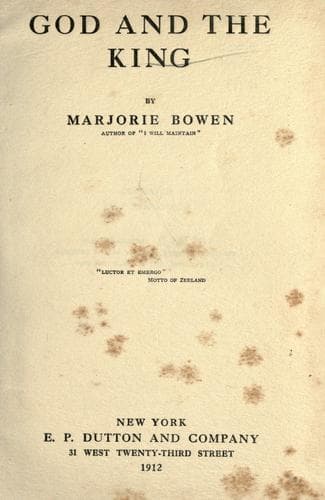
Great Britain -- History -- Revolution of 1688 -- Fiction; James II, King of England, 1633-1701 -- Fiction
The plan had been an utter failure; each faction wanted the supreme
control. The Whigs wanted the King to become their champion, and avenge
them indiscriminately on every Tory; the Tories, who had always been
opposed to William, refused to work with the Whigs; Danby, created
Marquess of Caermarthen at the Coronation, was furious because he had
not the privy seals; Halifax, to whom they had been given, grudged Danby
the Marquisate; the two Secretaries, Shrewsbury and Nottingham, were
scarcely on speaking terms; Russell, now Lord Orford, and Herbert, now
Lord Torrington, quarrelled fiercely over the naval affairs; at the
Treasury Board, Lord Mordaunt, now Earl of Monmouth and Lord Delamere,
both hot Whigs, did their best to disparage their colleague, Lord
Godolphin, who, of all the Government, was the quietest man and the one
most esteemed by the King; Clarendon, the Queen’s uncle, had refused to
take the oaths; and his brother Rochester was suspected of plotting with
James. There was, in fact, scarcely one Englishman, even among those
who had accompanied William to England, whom he could trust, yet the
advancement and favour he showed his Dutch friends was made the matter
for perpetual and noisy complaint.
On the other hand, the Church of England, which owed its very existence
to the Revolution, proved itself unreasonable and ungrateful; it refused
stubbornly to grant any concessions to Non-conformists, and wished
severe penalties visited on the Papists.
Added to this, the home government was rotten to the core, the army and
navy in a miserable state, the people overtaxed, business disorganised,
the treasury empty, credit low, every one discontented, Ireland in the
possession of James, a revolt in Scotland, and, on the Continent, the
French making unchecked progress, and the Dutch beginning to complain
that they were being neglected for the English.
When it is considered that the man who was to face and overcome these
difficulties was disliked, distrusted, misunderstood, and betrayed on
every hand, it can be no wonder that even his brave soul was drooping.
His position was in every way complex. By nature imperious, arrogant,
of the proudest blood in Europe, he had a high idea of the kingly
prerogative, and by instinct leant to the Tories; but the Whigs claimed
him as peculiarly their champion, and it was undoubtedly to their
influence that the Revolution was due. As King of England he was head
of the Anglican Church and swore to uphold it; but he was a Calvinist
himself, and the whole tenor of his life had been towards that broad
toleration which the Church regarded with abhorrence. He was avowedly
latitudinarian and set his face resolutely against any form of
persecution for religious belief, and while this attitude cost him the
support of the Church, his refusal to treat the Catholics harshly lost
him the alliance of the Dissenters, who regarded him as disappointingly
lukewarm in the true cause.
Public-domain text, read in full here on John Shaqi.
Reviews
Reviews
No reviews yet
Be the first to share your thoughts on this work.
Elsewhere in the archive
Join the Discussion
Join the discussion
Sign in to leave a comment or review.
Sign InorCreate an account