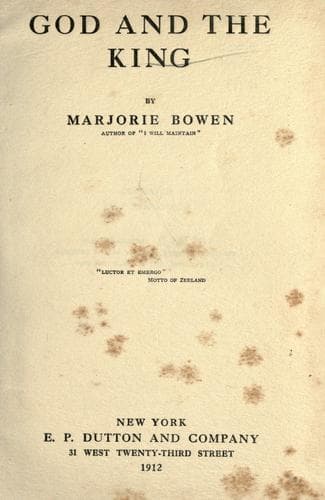
Great Britain -- History -- Revolution of 1688 -- Fiction; James II, King of England, 1633-1701 -- Fiction
The King went back and flung himself on his couch; he could not come
near sleep, but lay watching the long, pale beams of light the lamp cast
over the worn grass that formed the floor of the hastily constructed
tent.
His mind kept dwelling on his first campaign, his miserable army, his
own ignorance of all but book tactics, his lack of money, of
authority—yet that had been the first spark of that fire that now lit
Europe. He had formed and trained his own armies—Dutch,
Brandenburghers, Swedes, Germans, and lately the English—until they were
equal to those consummate French troops who had laughed at him in ’72;
but they fought with no more devotion and courage than the handful of
Hollanders who had rallied round him then, now incorporated into the
famous Dutch Guards, the most beloved of all his beloved army.
He thought of these Guards marching against Villeroy now, feared and
honoured, and his heart fluttered faintly with a fleeting pleasure that
they should ever face the French on these terms.
He closed his eyes and instantly there spread before him a vision of the
great banqueting hall at Whitehall hung with black, and the banners and
armours of his family, while in the centre was a mighty catafalque of
black velvet which bore an open coffin, at the foot of which lay a royal
crown and sceptre. She who rested there was covered to the chin in gold
stuff, and round her head was twisted her dark, curling, auburn hair.
The King sprang up and walked up and down the uneven ground; he drew
from under his shirt and cravat a long, black ribbon, to which was
attached a gold wedding-ring and a long lock of that same rich hair that
he had seen in his vision.
He paused under the lamp and gazed at it; in that moment he prayed that
he might find his death in to-morrow’s battle with as much passion as
any poor wretch ever prayed for hope of life. He was still standing so,
forgetful of time and place, when he heard voices without, and hastily
put the ribbon back over his heart.
The flap was raised and the figure of a young officer showed against the
paling sky.
"Is it M. van Keppel?" asked the King quietly.
"Yes, sire." The speaker entered. He had been sent with the King’s
commands to the Elector of Bavaria.
"M. de Bavaria understands everything?" inquired William.
"He is quite ready, sire."
"So are we," said the King. "I should think M. de Villeroy would make
the attack in an hour or so—the dawn is breaking, is it not?"
"The sun was just rising, sire, above the river, as I rode from the camp
of His Highness."
"Yet the light is very faint here. Will you, Mynheer, light the other
lamp?" The King spoke gently, but he had quite regained that command of
himself which rendered his demeanour so stately and impressive.
M. van Keppel obeyed and was then retiring, but William, who was seated
by the table, asked him to stay.
"I may have another message for you," he added.
The officer bowed.
Public-domain text, read in full here on John Shaqi.
Reviews
Reviews
No reviews yet
Be the first to share your thoughts on this work.
Elsewhere in the archive
Join the Discussion
Join the discussion
Sign in to leave a comment or review.
Sign InorCreate an account