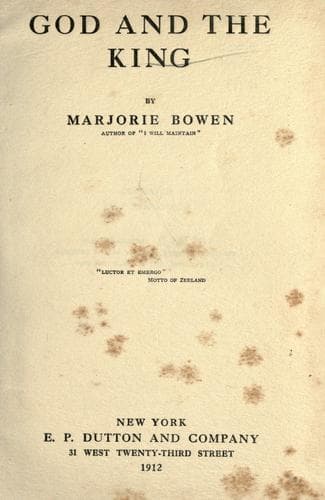
Great Britain -- History -- Revolution of 1688 -- Fiction; James II, King of England, 1633-1701 -- Fiction
William rang the little hand-bell near him and a valet instantly
appeared from the curtained inner portion of the tent. The King lived
very simply when at the camp. He now asked for wine, and when it was
brought made M. van Keppel drink with him, which honour caused the young
soldier to redden with pleasure.
"I hear," said William, "that the garrisons of Dixmuyde and Deynse have
been sent prisoners to France. That breaketh the treaty we made for the
exchange of captives—treachery and insolence, it seemeth, are the only
methods of France."
"Treachery and insolence will not for ever prevail," answered Joost van
Keppel, in his sweet, ardent voice. "The fortunes of Your Majesty begin
to overleap the arrogance of France."
"There will be a great battle to-day," remarked the King quietly and
irrelevantly.
The powerful summer dawn, strengthening with every moment, penetrated
the tent and mingled with the beams of the two lamps. The King sat in
the crossed lights; his gentleman knelt before him, fastening the great
gilt spurs to his close riding-boots. He looked at Joost van Keppel
gravely and kindly; his face, pale in its proper complexion, was tanned
darkly by the Lowland sun; his eyes were extraordinarily bright and
flashing, but languid lidded and heavily shadowed beneath; his large,
mobile mouth was set firmly; his long, thick curls hung over his black
coat, across which showed the blue ribbon and star that he had not
removed since he had reviewed his forces yesterday.
"Mynheer," he said to M. van Keppel. "Lift the flap and look out——"
The young Dutchman obeyed and a full sunbeam struck across the dim
artificial light.
"A fine day," remarked William; he was ever fond of sun and warmth.
As M. van Keppel stood so, holding back the canvas and gazing over the
tents that spread across the plain of the Meuse, a gentleman, armed on
back and breast with a gold inlaid cuirass, wrapped in a black silk
mantle and carrying a hat covered with white plumes, rode up,
dismounted, and entered the King’s tent without a word of ceremony.
M. van Keppel bowed very respectfully; it was the Earl of Portland.
On seeing the King alone with the young officer his face darkened; he
answered the King’s greeting of unconscious affection with stern
brusqueness.
"There are letters from England—I met the messenger," he said, and laid
the packet on the table by the wine-glasses.
Joost van Keppel was quick to see the instant shock that William
quivered under, and to perceive the cause of it. When last the King had
been at the war not a post had arrived from London without a letter from
the Queen. The young man thought Portland had acted with some
harshness; he came forward and said impulsively—
"Letters from England, my lord, are not of such importance that they
cannot wait till after the battle."
This was to Portland incredible impertinence; he stared at the flushed,
generous face with bitterly angry eyes; but William seemed relieved.
Public-domain text, read in full here on John Shaqi.
Reviews
Reviews
No reviews yet
Be the first to share your thoughts on this work.
Elsewhere in the archive
Join the Discussion
Join the discussion
Sign in to leave a comment or review.
Sign InorCreate an account