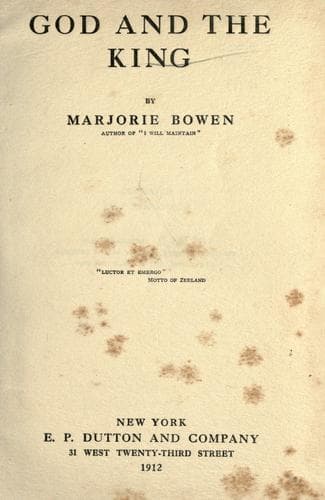
Great Britain -- History -- Revolution of 1688 -- Fiction; James II, King of England, 1633-1701 -- Fiction
He spoke with a personal emotion that surprised the Englishmen, who
believed that his relations with the King were painfully strained. They
respected him for his loyalty, though none of them had ever liked him,
and Somers at least gave him a quiet look of sympathy.
Shrewsbury broke out into half-hysterical petulance.
"Why are we doing it all? What use is there in any of it? We might as
well give it up now as afterwards. I confess that I have not the health
or spirit to endure more of it."
Mr. Montague smiled; he knew perfectly well the motive behind every
action he undertook, and what was the object of his labours. The
younger son of a younger son, and ten years ago a Poor Scholar at
Cambridge, he was now one of the greatest men in the Three Kingdoms, and
able to confer benefits on the Crown.
"There is no living in the world on any other terms than endurance," he
remarked complacently, "and a financier, your Grace, must learn to face
a crisis."
"The good God knoweth I am not one," returned the Duke gloomily.
"When is the general court to be held?" asked Portland; his one thought
to get the money from these men somehow, and return with it to the
desperate King.
"On the fifteenth," said the Chancellor, "and I have sufficient faith in
the patriotism of the shareholders to believe they will stand by His
Majesty."
Godolphin, who had been so silent hitherto that his presence was
scarcely noticed, spoke now from the window-seat.
"You have done us a great service, Mr. Montague. I think we should all
be very grateful."
This came gracefully from a member of that Tory party that had supported
Harley’s bank. Mr. Montague bowed, very gratified; my lord had that
soft way of conciliating possible enemies with outspoken courtesy.
Portland made no such speeches; he considered it only the bare duty of
the English to adequately support the King, whose life, ever since his
accession, had been one struggle to obtain money from the English
Parliament.
He took up his hat and saluted the company.
"I must endure with what patience I may till the fifteenth," he said,
and left them gravely.
He went out into the sunny streets of London, and turned towards the
Mall. There was no coach waiting for him; he was frugal in his habits
to a fault, and uninterested in any kind of display. No one would have
taken him for anything but a soldier home from Flanders, tanned at the
wars—an obvious foreigner with a stiff military carriage.
The town was very empty. The state of anxiety, suspense, and danger the
country was passing through was not to be guessed at from the well-kept
houses, the few leisurely passers-by, and the prosperous shops with
their wares displayed behind neat diamond panes.
Public-domain text, read in full here on John Shaqi.
Reviews
Reviews
No reviews yet
Be the first to share your thoughts on this work.
Elsewhere in the archive
Join the Discussion
Join the discussion
Sign in to leave a comment or review.
Sign InorCreate an account