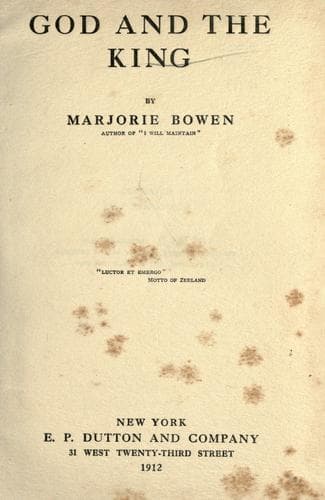
Great Britain -- History -- Revolution of 1688 -- Fiction; James II, King of England, 1633-1701 -- Fiction
It was William’s object to discover if Louis was in earnest. The
listlessness of Spain, the ambition of the Emperor must bow if once
France, England, and Holland came to terms. What he proposed was daring
and unconstitutional. He had not informed a single English politician
of his plan, and Portland, whom he thought to employ, was not even an
Englishman, but William was never stopped by any fear of responsibility.
If he could accomplish an honourable peace (the very best he could
obtain he knew would be only a breathing space, for there was the
tremendous question of the Spanish Succession ahead), he cared nothing
for the temper of the English parliament or the complaints of the
allies, and in the United Provinces he was practically absolute. He had
before suggested to Portland that he should write and open negotiations
with Boufflers, and had mentioned Hal, midway between Brussels and Mons,
as a likely place for an interview. He now, on Portland’s words,
reverted to this and discussed the details of the scheme that was to
give peace to Europe in his weary, low, and strained voice, broken by
constant coughs.
The forest of Soignies began to break; the trees became thinner and were
scattered to right and left like echelons of soldiers, the whole heaven
was clear of cloud, and the sun, just rising above the plains of
Brabant, filled the air with a steady colour of pearl-blue.
A little wind touched the trees, then was silent; the constant noise of
birds accompanied the tramp of the heavy infantry and the distant,
unequal rumble of the gun carriages and baggage waggons.
The King loosened his cloak, cast it over his holster, and looked back
at the army following him through the wood.
"If we sign peace this year this will be my last campaign," he remarked.
Portland looked at him quickly.
"The Spanish question—there will be war there—and before long."
"But I have so few years to live," answered the King simply; "for with
this peace my work would be done. No, I think I shall never lead an
army across the Netherlands again."
They rode clear of the trees now, and saw before them the beautiful
valley soft and veiled in the mists of morning.
The King fixed his eyes on the spot where Brussels lay. If Villeroy had
outmarched him and was bombarding the capital as he had bombarded it
last year, the allies had been checkmated and there would be little hope
for the prospects of peace.
Scouts were sent out to ascertain the movements of the enemy; no sign of
their fires could be discerned. William thought that his activity had
saved Brussels and that there were no fears from Villeroy. He pushed
on, and, by ten in the morning, after having ridden fifteen hours,
reached the still unmolested ramparts of the capital from which the
Spanish flag was yet flying.
Public-domain text, read in full here on John Shaqi.
Reviews
Reviews
No reviews yet
Be the first to share your thoughts on this work.
Elsewhere in the archive
Join the Discussion
Join the discussion
Sign in to leave a comment or review.
Sign InorCreate an account