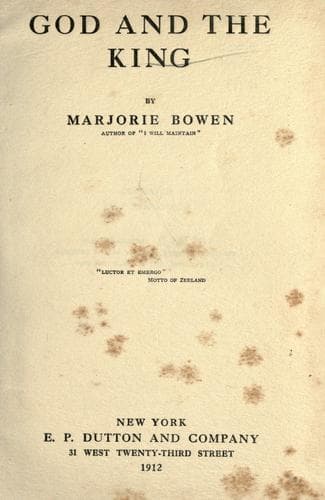
Great Britain -- History -- Revolution of 1688 -- Fiction; James II, King of England, 1633-1701 -- Fiction
He instantly took up his position before the walls and proceeded to
strongly entrench himself on the very spot from which Villeroy had
dropped his shells into Brussels near a year ago when the allies were
before Namur.
It appeared that he had saved the magnificent city by a few hours;
before midday the French came up, but, finding the confederate army
already so strongly fortified, fell back across Brabant without firing a
shot.
The King, as he rode about surveying the encampment, sent for Portland.
The Earl came, and the two men looked at each other steadily; the hasty
earthworks, the rising canvas, the sights and sounds of the camp were
about them, overhead the blazing blue faintly hazed with clouds of heat.
William held out his thin, bare right hand.
"Since I think you are resolute to leave me," he said, "I would have you
go to Hal to meet M. de Boufflers." He added with great sweetness, "I
put the fate of Europe in your hands, and could put it in none more
worthy."
CHAPTER IX
PEACE
The Earl of Sunderiand was again as great as he had been when he held
James Stewart infatuate in his power, and as well hated throughout the
country as then. The King had long consulted him in private, and now he
was recognized as principal adviser to the Crown, and carried the gold
key that was the symbol of the office of Lord Chamberlain.
He had no rival. Halifax was dead; Leeds a mere shadow; his intrigues
had brought about the resignation of Godolphin, who had been implicated
in the disclosures of Sir John Fenwick; Shrewsbury, stricken with
remorse at his own treachery and the King’s generosity, was but a figure
in the background; and the other ministers, even such as Romney, who was
William’s personal friend, had little influence; Portland’s power was
not what it had been, and his rival, M. van Keppel, largely owed his
fortunes to Sunderiand. The Lord Chamberlain was supreme in this year
1697, the year of the peace framed by Portland and Boufflers in the
orchard at Huy and signed by the Congress at the King’s palace of
Ryswick.
This peace was an honourable close to an honourable conflict. Louis
recognised William as King of England, and granted most of the terms
desired by the allies, not one of whom complained that they had been
forgotten or slighted by the King in the framing of the articles. The
delay of Spain and the Emperor to sign, despite William’s entreaties,
had resulted in the fall of Barcelona and Louis’ consequent rise of
terms, the principal of which was the retention of Strassburg—a severe
blow to Austria. But, on the whole, the peace was favourable to the
coalition, and in England and Holland at least was received with
unbounded rejoicing. William’s return from the Continent was the signal
for a display of loyalty as enthusiastic as that which had greeted the
exiled Charles in ’66.
Public-domain text, read in full here on John Shaqi.
Reviews
Reviews
No reviews yet
Be the first to share your thoughts on this work.
Elsewhere in the archive
Join the Discussion
Join the discussion
Sign in to leave a comment or review.
Sign InorCreate an account