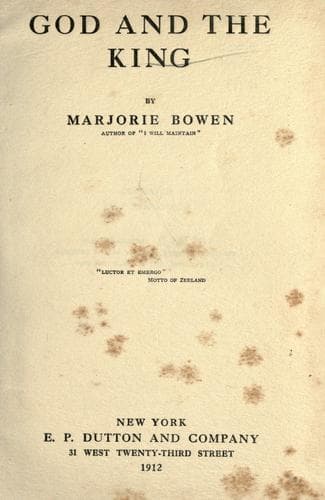
Great Britain -- History -- Revolution of 1688 -- Fiction; James II, King of England, 1633-1701 -- Fiction
He was waiting now, in the King’s gallery at Kensington, to intercept
and argue with Shrewsbury, whom he knew was about to have an interview
with William, and with the object, he suspected, of insisting on his
often refused resignation.
He came at last, after his time and slowly, with a languid carriage and
an unsteady step that expressed great wretchedness. Sunderland moved out
of the embrasure of the window; Shrewsbury paused; and the two noblemen,
alike only in birth and country, so totally different in character,
intellect, and aim, yet both in the same service, faced one another.
Shrewsbury looked ill, miserable, even slightly dishevelled, his dark
clothes were careless and plain, the beauty that had once made him
famous as "The King of Hearts" was scarcely to be traced in his strained
features, though he was not yet past his first youth. In contrast,
Sunderland, though worn and frail, looked less than his years, and was
habited very fashionably and gorgeously in black tissue of gold with
diamond buttons, his peruke was frizzled and powdered, and he wore a bow
of black velvet beneath his chin; his handsome, delicate features wore
that expression of watchful, smiling repose which was so seldom from his
face that it had come to be one with it, as the faint chiselling on an
alabaster bust.
Shrewsbury showed some agitated emotion as the Lord Chamberlain stepped
before him.
"I am due with His Majesty," he said.
"I know," answered the earl; "and I think I guess your business with the
King."
Shrewsbury paled and said nothing; a defiant look hardened his eyes.
"You," continued the Lord Chamberlain, "are going, my lord, to force
your resignation on His Majesty."
"Well—if I am?" Shrewsbury moistened his lips desperately.
"It is, your Grace, a most ill-advised thing to do."
"I have heard many people say that, my lord," answered the young duke,
"and I have allowed myself to be too long persuaded. I cannot and I
will not stay at Court."
Sunderland gazed at him steadily out of his long, clear eyes.
"You only give colour to the disclosures of Sir John Fenwick, which
every one disbelieved. And no one more strongly than His Majesty."
"I bear the taint—the imputation," muttered Shrewsbury. "I cannot and
will not endure it. My position is insupportable."
"Marlborough and Russell are in the same position, and find it easy
enough to bear," said Sunderland quietly.
The Duke answered with some pride—
"I am not such as they. They act from their standards—I from mine."
He thought, and might have added, that he was not such as the man to
whom he spoke. Sunderland was stained with treacheries, disloyalties,
corrupt practices, and shameless false-dealing, the very least of which
were more than the one lapse that was wearing Shrewsbury to misery with
remorse.
The Earl took another tone.
Public-domain text, read in full here on John Shaqi.
Reviews
Reviews
No reviews yet
Be the first to share your thoughts on this work.
Elsewhere in the archive
Join the Discussion
Join the discussion
Sign in to leave a comment or review.
Sign InorCreate an account