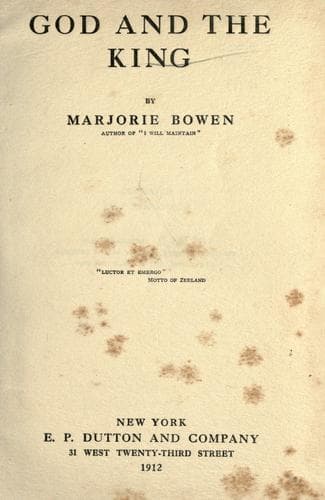
Great Britain -- History -- Revolution of 1688 -- Fiction; James II, King of England, 1633-1701 -- Fiction
"Think of the King. You call yourself friend to him; he is as harrassed
now as he ever was before the war. He hath not too many men to help
him—the Tories grow in strength every day. You have been of great
service to His Majesty—the greatest in ’88. Will you forsake him
now—when he needeth you most?"
Shrewsbury put out a trembling hand.
"I have heard these arguments before. Lady Orkney hath been soliciting
me to change my resolution—for the same reason that you bring forth.
But I am a broken man; I am ill; I must get to the country; I cannot
serve His Majesty——"
So speaking, in rapid, disconnected sentences, he gave a wild glance at
the Earl’s passive face, the fine lines of which had taken on an almost
imperceptible expression of contempt and disgust, and passed on to the
King’s cabinet, which he entered abruptly.
The King was, as usual, at his desk, which was placed between the tall
windows which looked on to the beautiful park, now grey and desolate
under the afternoon sky of mid-November.
A great fire burnt on the hearth, and the glancing light from it threw
into relief the furnishing of the room, every article of which bore
evidence to the exile’s wistful love of his own country. On the
mantelshelf were the tall yellow, white, and blue vases from Delft; the
brass fire-irons were Dutch, as were the painted tiles, the black,
heavily polished chairs and tables; the exquisite paintings of peaches,
carnations, grapes, and butterflies on the wall; and the elaborate china
calendar above the King’s desk. William was always consistently loyal to
the products of his own land; his full cravat, shirt, and wrist-ruffles
were now, as generally, of the fine Frisian lawn embroidery, and the
buttons of his black silk coat were of the wonderful filigree gold-work
for which the States were famous.
He looked up sharply as Shrewsbury entered, and seemed a little
disappointed, as if he had been expecting some one else; but instantly
commanded himself, and greeted the Duke affectionately.
Shrewsbury looked at him wretchedly, crossed to the hearth irresolutely,
then burst out impetuously—
"Sire—I must resign—I can take your wage no longer——"
The King’s full bright eyes swept over him in a quick glance of
understanding.
"I have told you," he said, with a gentleness that had a note of pity in
it, "that I hold you innocent of those scandalous slanders that villain
Fenwick flung. I have assured you, my lord, of my affection, of my need
and wish for your service."
Shrewsbury bit his lower lip, and stared blindly into the scarlet heart
of the fire.
"My health will not permit me——" he began.
"Ah, tush!" interrupted the King, with a little smile. "Your health is
good enough."
Compared to his own, it was indeed. Shrewsbury could not, for very
shame, argue that plea.
"I think you have another reason, your Grace," added William, kindly and
a little sadly. "And I am an old enough friend for you to confide in
me——"
Public-domain text, read in full here on John Shaqi.
Reviews
Reviews
No reviews yet
Be the first to share your thoughts on this work.
Elsewhere in the archive
Join the Discussion
Join the discussion
Sign in to leave a comment or review.
Sign InorCreate an account