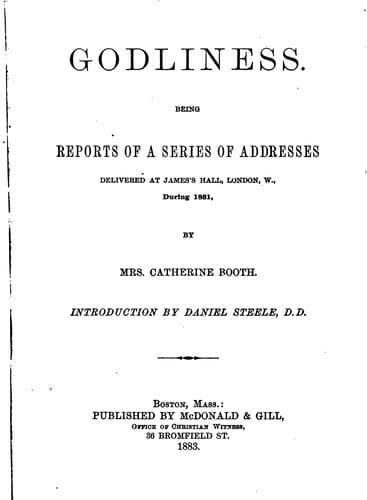
Godliness : being reports of a series of addresses delivered at James's Hall, London, W. during 1881Booth, Catherine Mumford
Religion
Godliness : being reports of a series of addresses delivered at James's Hall, London, W. during 1881
Booth, Catherine Mumford
Salvation Army -- Sermons; Sermons, English
In vain do we look for this heavenly plant amongst the unrenewed
children of men--it grows not on the corrupt soil of human nature; it
springs only where the ploughshare of true repentance has broken up
the fallow ground of the heart, and where faith in a crucified
Saviour has purified it, and where the blessed Holy Spirit has taken
permanent possession. It is the love _of_ God--not only love _to_ God,
but _like_ God, _from_ God, and fixed on the same objects and ends which
He loves. It is a Divine implantation by the Holy Ghost. Perhaps some of
you are saying, "Then it is useless for me to try to cultivate it,
because I have not got it,--exactly!" You may cut and prune and water
forever, but you can never cultivate that which is not planted. Your
first work is to get this love shed abroad in your heart. It is one of
the delusions of this age that human nature only wants pruning,
improving, developing, and it come out right. No, no! Every plant which
my Heavenly Father hath not planted shall be rooted up. If you want this
Divine love, you must break up the fallow ground of your hearts, and
invite the Heavenly Husbandman to come and sow it--shed it abroad in
your soul.
_Secondly_, I want you to note that this love is a Divine principle, in
contradistinction to the mere love of instinct. All men have love as an
instinct; mere natural love towards those whom they like, or who do well
for them. "If ye love them which love you, what reward have ye? do not
even publicans the same?" Wicked men love one another from mere natural
affinity, as the tiger loves its cubs. There is great confusion amongst
professors of religion on this subject. They feel sentiments of pity and
generosity towards their fellow-men, and they may even give their goods
to feed the poor, and yet not have a spark of Divine Charity in their
hearts. Saul, after God departed from him, was not wholly destitute of
generous feeling respecting his family and kingdom. Dives in hell had
some pity for his brethren! But neither of them had a spark of this
Divine Charity. Mind you are not deceived; millions are!
Let us note one or two points wherein a spurious and Divine Charity
utterly and forever diverge--disagree in nature.
_First._--Spurious Charity is selfish--is never exercised but
to gratify some selfish principle in human nature. Thousands of
motives inspire it--too many to enumerate; but we will glance at two
or three. We read in the context that a man might give his goods to
feed the poor, and his body to be burned, and yet be destitute of
true Charity.
Now what an anomaly. But we have wonderful illustrations that such a
thing is possible. First, a man may do this to support and carry out
a favorite system of intellectual belief of which he has become
enamored, just as men become absorbed, in politics, or in what they
consider the good of their nation, so that they will even go to the
cannon's mouth to promote it.
Public-domain text, read in full here on John Shaqi.
Reviews
Reviews
No reviews yet
Be the first to share your thoughts on this work.
Join the Discussion
Join the discussion
Sign in to leave a comment or review.
Sign InorCreate an account