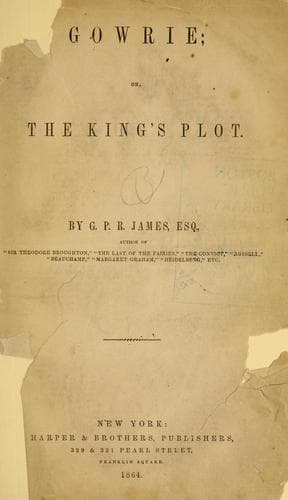
Gowrie; or, the King's Plot.James, G. P. R. (George Payne Rainsford)
General
Gowrie; or, the King's Plot.
James, G. P. R. (George Payne Rainsford)
Gowrie Conspiracy, 1600 -- Fiction
I can scarcely imagine that this account is not exaggerated. We find
that she showed no such honours to others, who stood much in the same
degree of affinity to herself as he did; and unless she wished
needlessly to alarm the King of Scotland, no cause can be supposed for
such conduct. That she treated Gowrie with great distinction, however,
is undeniable, and even marked her favour for him more strongly than
her old affection for his grandfather could account for. This course
was very dangerous to the young earl himself, for the court of England
at that time was thronged by spies of the Scottish monarch; and even
the most familiar friends and counsellors of Elizabeth conveyed
information to James of all that could affect his interest, to the
most minute circumstances. The natural desire of what is called
currying favour, of course, gave some degree of colour to the accounts
transmitted; and there is every reason to believe, from an examination
of the State Paper Office, that such intimations alone were given as
had a tendency to put the monarch on his guard, without discouraging
his hopes or diminishing his energies. The way for his advent to the
throne had been prepared long beforehand; whether from the general
considerations of policy, from personal ambition, or from avarice,
such men as Cecil had chosen their course, and were determined to
remove or overawe all competitors, and to insure the accession of the
King of Scotland. I am inclined to believe--without considering them
as anything more than mere mortals--that the purest spirit of
patriotism inspired those who thus acted. Every man of common sense
must have seen that most important ends were to be obtained by uniting
the crowns of Scotland, Ireland, and England upon one head; nor could
any one doubt that--apart from all considerations of the personal
character of the man--the means of maintaining his claims, of crushing
all competitors, and of establishing his power upon a firm and secure
basis, were more completely in the hands of the King of Scotland than
of any other person who could aspire to the English throne. His faults
were all personal, which never enter sufficiently into the
calculations of politicians; his advantages were those of position,
which almost always have too much weight with those who influence the
fate of empires. By personal character, no man was ever less fitted to
fill the throne of a great country, or to unite discordant races under
one sway, than James I.: by political position, no one could compete
with him in pretensions to the throne of England. Happy had it been
for Great Britain had such not been the case, for the vices of the man
more than compensated the advantages of the prince, and the weakness
of his successors consummated what his own wickedness began; but no
one can blame those who chose according to the lights they possessed,
and who smoothed the way for that which naturally appeared the best
for the whole nation at the time.
Public-domain text, read in full here on John Shaqi.
Reviews
Reviews
No reviews yet
Be the first to share your thoughts on this work.
Elsewhere in the archive
Join the Discussion
Join the discussion
Sign in to leave a comment or review.
Sign InorCreate an account