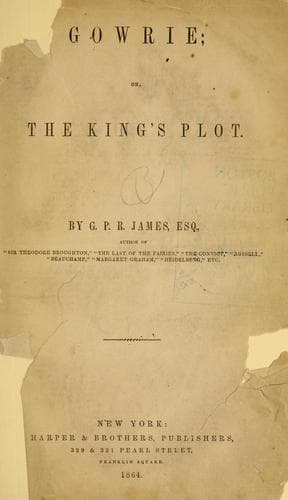
Gowrie; or, the King's Plot.James, G. P. R. (George Payne Rainsford)
General
Gowrie; or, the King's Plot.
James, G. P. R. (George Payne Rainsford)
Gowrie Conspiracy, 1600 -- Fiction
The reports which reached Scotland of the honours shown to the Earl of
Gowrie in the English capital, generated, in a jealous and irritable
mind, covetous of extended and despotic rule, a feeling of doubt and
dread most dangerous to its object; and the busy and gossiping spirit
of a small court did not fail to increase the unpleasant impressions
thus produced, by a thousand rumours, which had no foundation in
truth. Reports were circulated and credited, that Queen Elizabeth had
actually designated the Earl of Gowrie as her successor, and even
that, in order to unite two great claims to the crown which she held,
she had made all the arrangements for a marriage between that nobleman
and the Lady Arabella Stuart; one who, like himself, was not very
remote from the direct succession. These facts have been omitted
altogether, or slurred over by modern historians, in noticing that
part of history in which this young nobleman appears; but that such
rumours existed in England and Scotland can be proved from
contemporary authorities; and we can easily conceive the feelings with
which such a man as James was thus prepared to view one whose
influence was already redoubtable, on his return to his native land.
Could he have seen the private life of the earl, it is probable that,
although he might still have remained inimical, the king's fears would
not have assumed the character of hatred. From various motives, which
every one can conceive, Julia was not disposed to mingle with the
gaieties of a foreign court, or, before she was received and
recognised in her own land, to assume the position she was entitled to
in the society of the neighbouring state. She felt it no privation,
indeed--she sought it not--she cared not for it; but even if she had,
she would have forborne, and she had full compensation in the
tenderness of him she loved. Gowrie appeared at the court of England
alone: he put not forth on her behalf, claims which were to be decided
in a different country, and by different laws; and on the only
occasion when the queen jestingly alluded to his fair companion, he
replied, with that courtly reverence towards the sovereign to which
Elizabeth was accustomed, and that due respect for Julia's situation
from which he never deviated, "It is painful, madam, to be torn by two
duties and two inclinations. You may easily suppose it would be
grateful for me to linger here at your majesty's feet, but my duty,
both by kindred and by promise, is to escort my cousin back to
Scotland, in order to establish rights of which she has been too long
deprived. I trust, however," he added, with the air of gallantry which
pervaded Elizabeth's court, "that ere long I shall be enabled to
return, not alone to bask in the beams of your favour, but to ask a
share for one who, I may humbly say, is more worthy than myself of
that honour for which princes might well contend with pride."
Public-domain text, read in full here on John Shaqi.
Reviews
Reviews
No reviews yet
Be the first to share your thoughts on this work.
Elsewhere in the archive
Join the Discussion
Join the discussion
Sign in to leave a comment or review.
Sign InorCreate an account