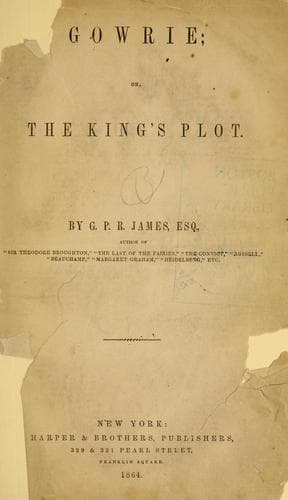
Gowrie; or, the King's Plot.James, G. P. R. (George Payne Rainsford)
General
Gowrie; or, the King's Plot.
James, G. P. R. (George Payne Rainsford)
Gowrie Conspiracy, 1600 -- Fiction
"Well, call him in," replied Lord Gowrie; and having rung a small bell
that stood upon the table, they were joined immediately by the earl's
servant.
"Get your beaver and your cloak, Austin Jute," said the earl; "we are
going out into the streets, and you must follow. Take broadsword and
dagger too. I know you can use them well upon occasion. Have you them
at hand?"
"A good workman never wants tools, my lord," replied the man; "and as
to using them, Heaven send the opportunity, and I'll find the means. A
man that threads a needle, ought to be able to stitch; and I who have
hammered hot iron in my day, should be able to use it cold, though men
say practice makes perfect, and I have had but little in your
lordship's service. However, what is early learned is long retained;
and a hand that is well acquainted with a cudgel remembers its use as
well as the back that bears the beating."
The earl and his friend both laughed. "There, there," cried Sir John
Hume, "in pity's name, good Austin, content yourself with ready-made
proverbs, and do not eke them out with your own manufacture."
"All as old as the King of Spain's wine, worshipful sir," replied the
man; "though all old things are not bad, a new doublet is better than
a worn cloak, and proverbs, like lenten pie, may get musty by keeping.
I shall have my pinking iron on before your worships are down the
stairs; and God send you a safe journey to the bottom, as I shall not
be there to take care of you."
CHAPTER III.
When the Earl of Gowrie had parted from his friend at the door of
Hume's lodging, he walked on, followed by his servant, for some four
or five hundred yards farther, till the wider and more fashionable
street deviated into a number of narrow and somewhat intricate lanes,
each, however, having its arcades on either side, with the three or
four upper stories of the houses built over them, so that two people
might have shaken hands from window to window. At the last house of
one of these lanes, where the street terminated at a canal, with a
bridge over it leading to the Treviso gate, the young nobleman
stopped, and using a great bar of iron which hung upon the door,
knocked three times aloud. He had to wait some time, however, before
the door was opened, and was just about to knock again, when an old
woman, with a lamp in her hand dangling by a long chain, appeared to
give him entrance.
"How are you, Tita?" he said. "I am sorry to hear that Signor Manucci
has been so ill. Can he see me to-night?"
"Oh yes, sir; he expects you," replied the woman, "and will go into
his own private study to receive you, though the signora thinks it may
hurt him."
Public-domain text, read in full here on John Shaqi.
Reviews
Reviews
No reviews yet
Be the first to share your thoughts on this work.
Join the Discussion
Join the discussion
Sign in to leave a comment or review.
Sign InorCreate an account