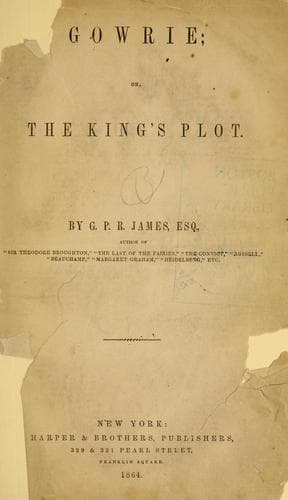
Gowrie; or, the King's Plot.James, G. P. R. (George Payne Rainsford)
General
Gowrie; or, the King's Plot.
James, G. P. R. (George Payne Rainsford)
Gowrie Conspiracy, 1600 -- Fiction
There are times when--we know not why--the spirit of the mind, if I
may use a strange term, seems completely to triumph over the mere
corporal part of our nature, to conquer its sensations, to make light
of its necessities, to overcome its habitual resistance almost without
an effort--times when soul seems to possess the whole, when every
faculty is subdued to thought. Vain is it to struggle against it--vain
to say I will read, I will sport, I will sleep. Thought replies, no;
and for the time we are her slave. Such was the case with Gowrie that
night; and though he gazed round the chamber as I have said, what it
contained made merely an impression upon the eye, which reached not
the mind within.
It was a large, wide, old-fashioned chamber, the walls of which had no
hangings, although two wide pieces of a tapestry, with which the whole
room had probably formerly been decorated, were drawn across the
windows. On one side of the room was a large bed, almost lost in the
extent of the floor, and having curtains of a dingy green hue, and of
a silk stuff, the manufacture of which had even then long passed away,
formerly called cendal. There was a small round table in the middle of
the room, a mirror in a black oak frame standing forth from the wall,
supported by two iron bars, a washing-table in the corner, and two or
three chairs. That was all that it contained; and, as I have said, it
was very large and very gloomy. Nevertheless, although the year was
approaching winter, there was something close and oppressive in the
atmosphere. It felt as if the windows had not been opened for many a
year. Gowrie did not remark it, but sat down at the table and fell
into thought again. He remained thus for more than an hour. I have
called it thought, but yet it was of that trance-like character
wherein all things seem more like impressions than ideas, when dead
affections rise up from the tomb of memory in the shape of living
existences, and from the future the shadows of unborn events, clad in
the forms of actual realities, present themselves for warning or
encouragement. There is no continuity, there is no arrangement, there
is no operation of the intellect. Mind sits as a spectator while
the pageant passes, called up before our eyes by some unnamed
power.--What?
Who can say? There are things within us and without us that we know
not of--that the hardest handed metaphysician has never been able to
grasp.
Public-domain text, read in full here on John Shaqi.
Reviews
Reviews
No reviews yet
Be the first to share your thoughts on this work.
Elsewhere in the archive
Join the Discussion
Join the discussion
Sign in to leave a comment or review.
Sign InorCreate an account