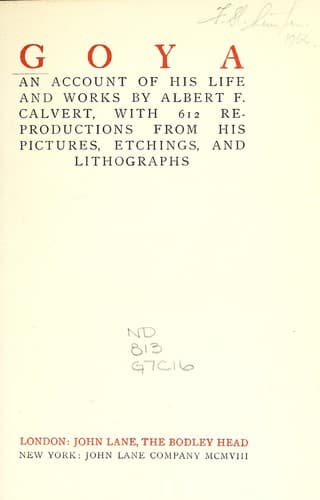
Goya, an account of his life and worksCalvert, Albert Frederick
History
Goya, an account of his life and works
Calvert, Albert Frederick
Goya, Francisco, 1746-1828
The Conde de la Viñaza in his _Life_ of Goya refutes every detail of
this story. It is said that while Goya was in Italy he secured a prize
offered by the Parma Academy of Fine Arts for a picture of ‘Hannibal
surveying Rome from a pinnacle of the Alps,’ but the Conde maintains
that Goya at this time was in Spain and that it was in his own country
he painted his picture and carried off the second prize. In the _Mercure
de France_ of January 1772 we read: ‘Le 27 Juin dernier l’Académie
Royale des Beaux Arts de Parme tint sa séance publique pour la
distribution de ses prix. Le sujet de peinture était: “Annibal vainqueur
du haut des Alpes jette ses premiers regards sur les campagnes
d’Italie.”... Le premier prix de peinture a été accordé au tableau qui
avait devise: “Montes fregit aceto,” et qui était de monsieur Paul
Borroni etc. Le second prix de peinture a été remporté par M. François
Goya romain (_sic_), élève de M. Vajeu, peintre du roi d’Espagne.’
The following paragraph by M. Paul Mantz from the same source is quoted
into the _Archives de l’art français_: ‘L’Académie a remarqué avec
plaisir dans le second tableau un beau maniement de pinceau, de la
chaleur d’expression dans le regard d’Annibal et un caractère de
grandeur dans l’attitude de ce général. Si M. Goya se fût moins écarté
dans sa composition du sujet du programme, et s’il eût mis plus de
vérité dans son coloris, il aurait balancé les suffrages pour le premier
prix.’
The Conde de la Viñaza, Goya’s Spanish biographer, maintains that this
picture was painted and the prize won before the artist went to Italy,
and he proves, by the publication of documents preserved in the Archives
of the Pilar Cathedral at Zaragoza, that in October 1771 the painter,
forsaking Madrid, was back on the banks of the Ebro in the enjoyment of
an enviable reputation. This is in direct contradiction to the old
stories describing a love adventure as the reason for his sudden and
hasty departure from Rome. A mad enterprise which had for its object the
rescue of a young maid from a convent ended, it is said, in his capture,
and he ‘only escaped the gallows by the most reckless and headlong
flight.’ This much we know, that Goya was in Zaragoza in 1771. He
returned not as a fugitive and an outlaw, but as a reputable citizen
having the confidence of the Cathedral authorities, who commissioned him
to paint the quadrangular vault in the Holy Chapel. The fresco which he
prepared as a proof that ‘he was experienced in this kind of painting,’
was submitted to the Building Committee of the Cathedral, on November
11, 1771, together with the director’s assurance that it had received
the approval of experts, and with Goya’s offer to paint the vault of the
small choir for 15,000 reals, he providing the labourers and materials.
The Committee, having heard this proposition and recognising it as
better than that made by Don Antonio Velazquez, who asked 25,000 reals
Public-domain text, read in full here on John Shaqi.
Reviews
Reviews
No reviews yet
Be the first to share your thoughts on this work.
Join the Discussion
Join the discussion
Sign in to leave a comment or review.
Sign InorCreate an account