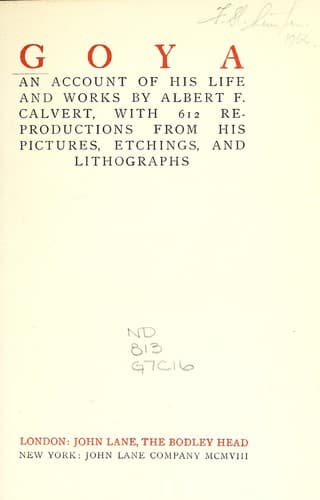
Goya, an account of his life and worksCalvert, Albert Frederick
History
Goya, an account of his life and works
Calvert, Albert Frederick
Goya, Francisco, 1746-1828
Taking into consideration these harmonious dealings of the
supplicant with D. Francisco Bayeu, which created no motive for
resentment, and were governed by the principles and rules
prescribed in the first and only conversations regarding the
matter, who could think that the expositor had been wanting in
respect to Bayeu? There are those who think so, because when the
work was well in hand, they wished to make him understand that the
agreement with Bayeu was that he should interfere as much as he
liked with the expositor’s work, and that the latter should obey
him as a subordinate in execution, placing of figures, style,
colouring, and so forth; in a word make him a mere executor and
mercenary subordinate; but as this was in direct opposition to what
had been agreed, it would have been discreditable to his honour to
yield, as he would be losing what his merit had won for him, and he
could not therefore so humiliate himself, for he knew that the
previous offices were sufficient, and that similar ones if
continued would not make them anything but his own production. D.
Francisco Bayeu’s warning to you that he would not be responsible
for his part of the work, only shows that his object was to create
a want of confidence that should cause coercion to be exercised,
which was justly resisted, for doubt as to skill and success sat
ill on D. Francisco, who knew quite well of the honours acquired by
the expositor in Madrid, both from the Royalties and from all who
had seen his productions, all executed by himself without the
slightest direction from any one.
After this, things were artfully circulated against the conduct of
the expositor, concerning his temper, proceedings and dealings with
Bayeu, he being accused of hauteur, pride and stubbornness.
Thereafter malice prepared the blow, long premeditated, of first
creating personal disaffection, and then disaffection with his
work; as shown by the reception of his work in the dome of the
Cathedral of Our Lady. The criticism passed by some persons can
only be attributed to this, because all its merit is unobserved and
only the defects suggested by caprice or ignorance are sought.
He has suffered with resignation the insults to his honour, he has
had the patience to see that the same Bayeu who impaired his credit
with insinuating words, and the deceitful complaint that he was
responsible for the success of the work, and that he would have to
give an account of the confidence placed in him, and that the
supplicant was depriving him of this satisfaction because he would
not allow him to correct or alter his productions; on other
occasions defended the expositor, exalting his merit, acknowledging
his skill and the correctness of his painting.
Public-domain text, read in full here on John Shaqi.
Reviews
Reviews
No reviews yet
Be the first to share your thoughts on this work.
Join the Discussion
Join the discussion
Sign in to leave a comment or review.
Sign InorCreate an account