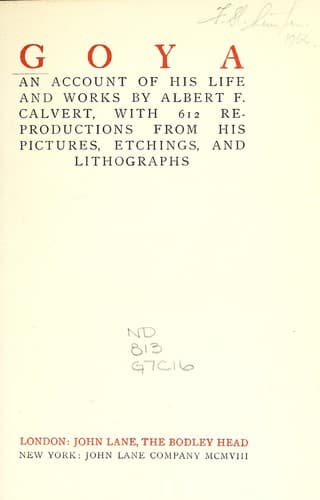
Goya, an account of his life and worksCalvert, Albert Frederick
History
Goya, an account of his life and works
Calvert, Albert Frederick
Goya, Francisco, 1746-1828
vanity of the Count-Duke of Olivarez, painted his portrait in a suit
which was not his own.... Goya painted moral life hyperbolically
idealised in his effigies of the kings, because he was painter to the
Household and protected by the Crown and the Court, although he was
rather the protector of his protectors. In all the other portraits of
statesmen, politicians, literati, scientific men, actors,
bull-fighters, priests and artists, Goya harmonised exactly the body and
the mind. How marvellously he caught the faces of the men of great
minds! How beautifully the moral and intellectual qualities of the
person represented are shown!’
A second and more cautious reading of the foregoing passage was required
to convince us that it was written without sarcasm, and was meant to
express a sober estimate of the qualities which the writer discovered in
the pictures referred to. Personal taste, as we have remarked elsewhere,
counts for much in the whole field of art, and in the opinion which is
quoted the Conde de la Viñaza has the field practically to himself.
Nearly all Goya’s critics and admirers are united in their appreciation
of the merciless and remorseless frankness, the pitiless satire, the
mocking, saturnine faithfulness of the likenesses. Sir William
Stirling-Maxwell misses the point of the equestrian portrait of Charles
IV. when he remarks that ‘the poor imbecile king, in the blue uniform
and cocked hat of a colonel of the guards, mounted on a sober brown
charger,’ is ‘an example of the dignity which may be conferred, by a
skilful hand, on the most ordinary features and expression, without
sacrificing the resemblance.’ But who beside Viñaza and Stirling-Maxwell
could detect anything but a burlesque of kingly dignity in this
grandly-uniformed, coarsely-made and coarse-faced Bourbon who sits
‘asthmatic and fat, upon his fat asthmatic horse, with his fat asthmatic
dog’--a study which moves a German critic to remark, ‘How like a Moloch
he appears, an evil god who has battened upon the life-blood of his
people.’
Public-domain text, read in full here on John Shaqi.
Reviews
Reviews
No reviews yet
Be the first to share your thoughts on this work.
Join the Discussion
Join the discussion
Sign in to leave a comment or review.
Sign InorCreate an account