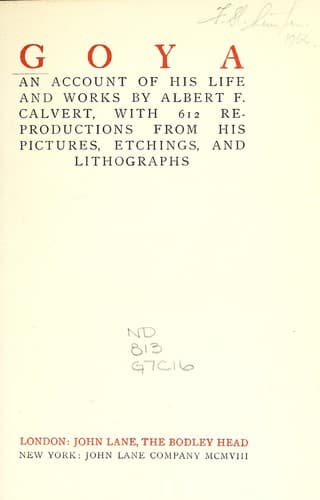
Goya, an account of his life and worksCalvert, Albert Frederick
History
Goya, an account of his life and works
Calvert, Albert Frederick
Goya, Francisco, 1746-1828
The portraits of his sensuous, passion-ridden queen are equally
fearless, true even to brutality. Maria Luisa was a courtesan seated
upon the throne of Spain. Velazquez, it has been wisely said, redeemed
the face of Mariana of Austria in his portrait by making her
unapproachable icy pride the keynote in his composition. Goya extenuates
nothing. He shows the queen, _décolletée_ to vulgarity in her insolently
vulgar gown, with gleaming arms and bosom exposed as a snare, which is
watched over by the greedy, hawk-like eyes. It is the woman she was, the
‘woman who loved men better perhaps than she was loved by them,’ the
courtesan that the artist knew and flattered and despised. Of the
picture of the ‘Family of Charles IV.,’ with its fourteen life-size
figures, it has been written that it ‘mirrors the hidden merriment with
which Goya recorded the Court history.’ Here is a faithful exposition of
Goya’s estimate of the Spanish royal family; an estimate which has never
been so remorselessly expressed by any other delineator of royal groups.
They are depicted in their resplendent uniforms and rich gowns, they
have all the dignity that is derived from gorgeous trappings, but Goya
has not spared them, or us, a tittle of their pitiful stupidity, their
coarse insolence, their mental and moral degeneracy. ‘The heads are
admirably painted, as Gautier admitted, ‘and are full of life, delicacy
and intelligence’; but the French critic’s general verdict upon the
group represented is his best tribute to the genius of the painter;--‘a
grocer’s family who have won the big lottery prize.’
The more closely one studies these royal portraits the more one becomes
convinced of their truth. To-day they remain as real to us as the
sympathetic, Velazquezesque likenesses of the painter Bayeu in the
Prado, or of Dr. Peral in the National Gallery. It is almost impossible
for any one to be in a position to award the palm for supreme excellence
among Goya’s portraits, for besides being so numerous, they are widely
distributed among the aristocratic families of Spain, and many are
practically inaccessible to the student. There are fewer than two dozen
of his portraits in the Prado, only two in the National Gallery, and one
in the Louvre. Few people are familiar with more than a certain number
of his portraits. For this reason there are many different opinions as
to the comparative merit of his pictures, but the individual opinions
all constitute a remarkable tribute to the painter’s genius in catching
the likeness and reflecting the character of his subjects.
Public-domain text, read in full here on John Shaqi.
Reviews
Reviews
No reviews yet
Be the first to share your thoughts on this work.
Join the Discussion
Join the discussion
Sign in to leave a comment or review.
Sign InorCreate an account