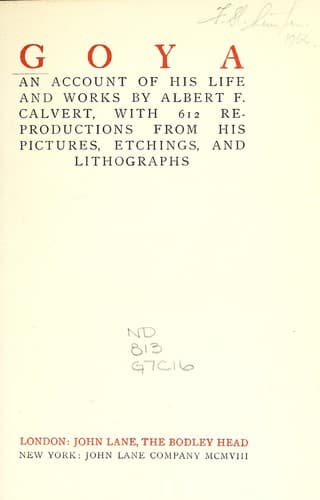
Goya, an account of his life and worksCalvert, Albert Frederick
History
Goya, an account of his life and works
Calvert, Albert Frederick
Goya, Francisco, 1746-1828
impression of pathos than before this presentment of a soul rather than
a person, before this face enveloped in transparent veils, with life
showing in the eyes, and in that life a melancholy realisation of
approaching death.’
Goya’s portraits, as we have said, are so numerous that it is only
possible to deal here with a brief selection of them. In his large and
varied gallery he displays so much versatility that it appears
impossible that they could all have been conceived by the same mind and
painted by the same hand. His treatment is alternately rough to the
verge of violence and as smooth as the work of a miniaturist; his tones
are crude and heavy or luminous and glowing, as the sitter appeals to
his mind; he makes his queen a confessed harlot and his little grandson
the incarnation of dainty boyhood. The portrait of his wife, now in the
Prado, is a work of the highest excellence, so are the beautiful
representations of the Duchess of Alba, the vivid impression of Asensi,
the delicious portrait of the Marquesa de Pontejos, the
Gainsboroughesque study of the Conde de Florida Blanca, the equestrian
painting of General Palafox, the dashing, almost contemptuously vivid
likeness of Godoy, the striking portrait of Guillemardet so
enthusiastically eulogised by M. León Legrange (_Gazette des
Beaux-Arts_), and those of the Duke of Osuna, of Felix Colón,
Jove-Llanos and Ventura Rodriguez, of Martincho and Romero, the
bull-fighters, of Pignatelly, General Urrutia, of the royal children,
and of himself, painted when still young--each portrait bears the stamp
of Goya’s genius, each expresses an individuality in his individual
style, each is finished because its effect is true.
Goya’s portrait of the Duke of San Carlos, the most loyal friend of the
son of Maria Luisa, has won the admiration of many painters and critics.
The head is beautifully painted, the posing is natural and graceful, the
figure lives and breathes. For this ‘miracle of art,’ as Viñaza styles
it, Goya used only a few colours, which he spread over the canvas with
an energetic and grandiose brush, each stroke being the expression of an
æsthetic thought and the perfection of the technique of painting. The
portrait, ‘which legitimises Goya’s descent from Velazquez,’ is said to
be like the work of Rembrandt in its clare-obscure, of Watteau in its
correctness, and of Titian in its delicacy and freshness. But there is
no end to the expressions of admiration which Goya has inspired. Eduardo
Rosales went to Zaragoza annually to visit Goya’s portrait of the Duke
of San Carlos, and on one occasion, when he had been lifted by a friend
that he might study the face of the portrait, he is reported to have
exclaimed, ‘My friend, such painting will never be seen again.’
Public-domain text, read in full here on John Shaqi.
Reviews
Reviews
No reviews yet
Be the first to share your thoughts on this work.
Join the Discussion
Join the discussion
Sign in to leave a comment or review.
Sign InorCreate an account