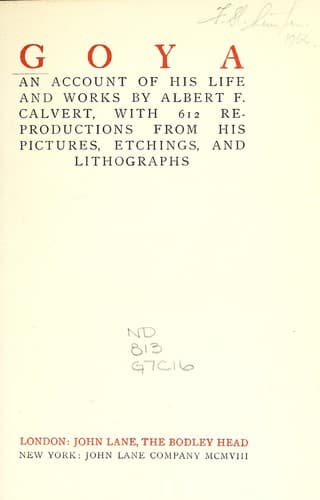
Goya, an account of his life and worksCalvert, Albert Frederick
History
Goya, an account of his life and works
Calvert, Albert Frederick
Goya, Francisco, 1746-1828
In 1798 Goya was intrusted with the decoration of the newly built church
of San Antonio de la Florida, which had sprung into existence in 1720
as a primitive hermitage, had been destroyed when the El Pardo road was
made in 1768, was re-erected two years later, and in 1792 was replaced
by the present elegant edifice, which was built at the expense of the
royal patrimony, after the plans of the celebrated architect, Ventura
Rodriguez. The outside of the building is of good architectural style,
the interior is small and elegant, and well suited to the rank and
fashion which frequented it. The Church was opened for worship on July
1, 1799, and we read that ‘Madrid went wild with excitement at the glory
of Goya’s achievement.’
Don Juan de Dios de la Rada y Delgado, who supplied the text for the
volume of aquafortis engravings of these frescoes which D. José Moria
Galvan y Candela executed in 1897, tells us that they were wholly in
accord with the conditions of the time. But the sentiment of Mr.
Rothenstein is nearer to the truth when, in speaking of these frescoes,
he says that he can remember nothing which gave him so clear an idea of
Goya’s cynicism. ‘Imagine,’ he writes, ‘a coquettish little church with
a white and gold interior, more like a boudoir than a shrine, but
furnished with altar, and seats, and confessionals. One’s nostrils
expect an odour of _frangipane_ rather than incense, and it must be
admitted that Goya’s frescoes do not strike a discordant note in this
indecorously holy place.’
Public-domain text, read in full here on John Shaqi.
Reviews
Reviews
No reviews yet
Be the first to share your thoughts on this work.
Elsewhere in the archive
Join the Discussion
Join the discussion
Sign in to leave a comment or review.
Sign InorCreate an account