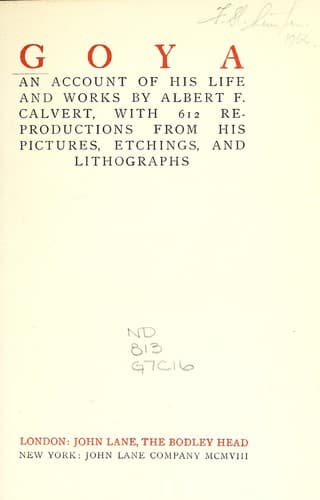
Goya, an account of his life and worksCalvert, Albert Frederick
History
Goya, an account of his life and works
Calvert, Albert Frederick
Goya, Francisco, 1746-1828
The subject of the main composition covers the cupola, and contains
upwards of a hundred figures considerably over life-size. The picture
illustrates the miracle ascribed to St. Anthony of Padua, who restored
to life the corpse of a murdered man in order that he might reveal the
name of his assassin and rescue an innocent man who was about to be
executed as the perpetrator of the crime. The scene is enclosed by a
painted railing which surrounds the entire composition. We see the saint
standing on an eminence against a luminous background. His life-giving
words have just restored the corpse to consciousness. The man leans
forward, supported in the arms of a companion, with his hands clasped in
an attitude of profound veneration, his expressive face looking fixedly
upon the saint with a gaze of surprise and gratitude. The central
figures are surrounded by a motley crowd of men, women, and children,
some of whom express their astonishment by eloquent gestures, while
others appear indifferent to the miracle that is being performed, and
one or two frolicsome boys are seen astride the figured railing. On the
spandrils, the intrados, the curvilineal triangles of the arches, and
behind the high altar, are groups of angels and cherubs. The angels are
beautifully clothed and almost wanton in their human loveliness, the
babes are entirely without the illusion of divine origin. It has been
said that in this composition Goya perfectly interpreted the spirit of
the Church de la Florida; certain it is that these angels with ‘the skin
of a camellia, eyes of fire, and the beauty of a harlot,’ which move
with audacious freedom of attitude, ‘not in pure spheres of blessedness,
but in an atmosphere of atoms of gold illuminated by an Asiatic sun, are
the strangest and most beautiful creatures that ever adorned a
consecrated house.’
Public-domain text, read in full here on John Shaqi.
Reviews
Reviews
No reviews yet
Be the first to share your thoughts on this work.
Elsewhere in the archive
Join the Discussion
Join the discussion
Sign in to leave a comment or review.
Sign InorCreate an account