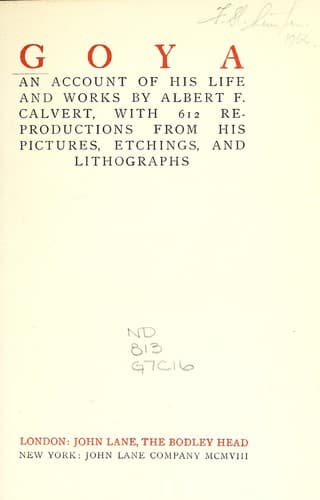
Goya, an account of his life and worksCalvert, Albert Frederick
History
Goya, an account of his life and works
Calvert, Albert Frederick
Goya, Francisco, 1746-1828
It is not possible in the space at our command to review these
‘Caprichos’ in detail, and fortunately it is not necessary. The reader
can examine the plates for himself and study their details. He will
remark the skill with which the engraver endows ‘The Garroted Man’ with
its sombre, gruesome tone; the sense of the unavailing, despairing
effort with which the living skeleton in ‘And yet they do not go’ (Plate
369) supports the slab of stone which must inevitably fall and crush the
crouching, scarcely human wretches who anticipate their fate with
expressions of such lurid horror. One can feel the violence of the wind
that buffets the women in ‘A Bad Night’; we enter into the terror of the
woman who is employed in her hideous task in ‘Tooth Hunting.’ Here
indeed, ‘horror confronts us; corruptness is imagined with an
unapproachable depth of grotesqueness.’ In all the realm of art there is
nothing to compare with the horror and grotesquerie of these Caprices.
Goya’s next work was the thirty-three plates of ‘The Tauromachia.’ This
series of engravings was so brilliant in execution and appealed so
strongly in their theme and treatment to the Spanish national affection
for the bull-ring, that doubtless they would have brought the etcher
even greater contemporary fame than the larger series, but for some
unexplained reason, they were not publicly issued until after his death
and the death of his only surviving legitimate son. In the ‘Tauromachia’
Goya made less use of aquatint and aquafortis, and, as in his later
etchings, relied more and more upon the needle to produce his effects.
These scenes of the bull-ring represent the different phases of the
combat and the surpassing feats of its most famous exponents. The
‘Caprices’ may appeal more strongly in some respects, but the drawing in
the plates of the ‘Tauromachia’ is extremely light and facile, and the
illusion of vigorous movement is seen in them all.
Public-domain text, read in full here on John Shaqi.
Reviews
Reviews
No reviews yet
Be the first to share your thoughts on this work.
Elsewhere in the archive
Join the Discussion
Join the discussion
Sign in to leave a comment or review.
Sign InorCreate an account