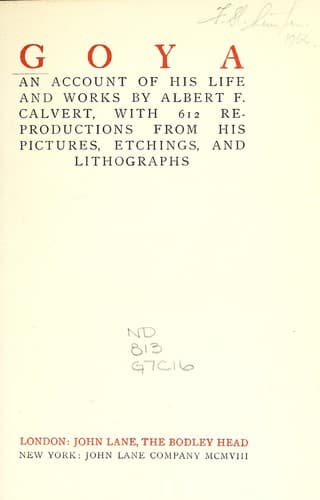
Goya, an account of his life and worksCalvert, Albert Frederick
History
Goya, an account of his life and works
Calvert, Albert Frederick
Goya, Francisco, 1746-1828
It is one thing to admire, even to understand, the technique of the
‘Caprichos,’ but to understand the precise significance of many of the
plates is almost impossible. Perhaps the titles printed by Goya beneath
the plates are the best guide to their meaning. The only reward to be
derived from reading ingenious meanings into the prints is the personal
interest one finds in the exercise. The series may be divided into three
classes; the first are humorous satires of the foolishness and
rottenness of the life of the period; the second are scathing assaults
upon the ignorance and greed of the priesthood and the corruptness of
the civic institutions; and the last are visions of witches and demons,
which may be classed as pure phantasies. There is a depth of meaning in
every plate, for Goya reproduces for us in them not only what he has
seen, but what he has felt. The first plate illustrates a marriage of
convenience, and we are shown the girl-bride being presented to her
hideous suitor by her more hideous mother. Over and over again we are
presented with this type of the ‘complaisant mother,’ which has been
described by Théophile Gautier in illuminating prose. ‘It is impossible’
he writes, ‘to fancy anything more grotesquely horrible, more viciously
deformed. Each of these frightful old shrews unites in her own person
the ugliness of the seven capital sins; compared to them the Prince of
Darkness himself is pretty. Just fancy whole ditches and counterscarps
of wrinkles; eyes like live coals that have been extinguished in blood;
noses like the neck of an alembic covered with warts and other
excrescences; nostrils like those of an hippopotamus rendered formidable
by stiff bristles; whiskers like a tiger’s; a mouth like the slit in the
top of a money-box, contracted by a horrible and convulsive grin; a
something between the spider and the multiped which makes you feel the
same kind of disgust as if you had placed your foot upon the belly of a
toad.’ The description is horrible even as Goya’s engravings are
horrible, and as excellently true as the work by which it was inspired.
Public-domain text, read in full here on John Shaqi.
Reviews
Reviews
No reviews yet
Be the first to share your thoughts on this work.
Elsewhere in the archive
Join the Discussion
Join the discussion
Sign in to leave a comment or review.
Sign InorCreate an account