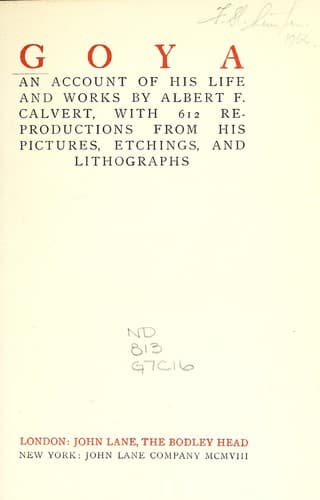
Goya, an account of his life and worksCalvert, Albert Frederick
History
Goya, an account of his life and works
Calvert, Albert Frederick
Goya, Francisco, 1746-1828
another moment, his hand had represented.’
A very interesting series of drawings and etchings are preserved in the
Print Room of the British Museum. Of these ten are reproduced in this
book for the first time. The Goya collection in the Museum consists of
eight original drawings, a holograph letter of Goya and no fewer than
two hundred and eighty-one separate works, comprising etchings and
lithographs of the Proverbs, Caprices, Tauromachia, and Disasters of
War, and the subjects after Velazquez. They are all in a splendid state
of preservation. Of the selection made for the present volume (Nos.
601-12), the portrait of the Duke of Wellington (601) and ‘A Lost Soul’
(605), have been reproduced by Mr. Rothenstein. The sketch of the Duke,
whom Goya in the letter referred to, writes ‘Weelingthon,’ served the
painter in executing the large portrait. It was made on the day
following the battle of Salamanca (1812), when Marmont was defeated on
the field of Arapiles. The ‘Lady and Gentleman on Horseback’ (No. 602)
have not been identified, although the picture is evidently a portrait.
The head of Fray Juan Fernanez (No. 603), drawn at the moment of his
last breath, is a very powerful sketch. In No. 609 the artist depicts
misery in a few masterly touches, and in Nos. 607, 608, and 609 he
illustrates proverbs with his peculiar freakish fancy. The study of
bulls (610) is another spirited sketch. The remaining plates represent
scenes of the bull-ring.
Goya still brooded over the misfortunes which the Royal family and their
hated favourite between them had brought about by folly, ignorance, and
baseness; and over the sufferers, the common people, who still
sacrificed their lives to reinstate their corrupt but accustomed
oppressors. But the end was near. The leading patriots, assembled at
Cadiz, were engaged in framing a constitution which was to mark the
commencement of modern Spain. Meanwhile Wellington was driving the
French troops before him--Olivenza, Fuentes de Oñoro, Almeida, Albuera,
Ciudad Rodrigo, and Badajoz indicate the line of their retreat. The
country was being drained and devastated to provide money for continuing
the war. Joseph was providing bull-fights and shows to divert the mind
of the Madrileños from the national misery. Napoleon was overwhelming
his brother with blame for a state of affairs which was neither of his
making nor controlling. Madrid, cut off from supplies, was wasted by an
appalling visitation of famine which lasted from September 1811 to
August 1812, when Wellington’s liberating army reached the capital to
find that Joseph had already beaten a retreat. The Napoleonic rule was
over. Joseph returned to Madrid, but it was only to pack up his
belongings, to loot churches and palaces and retire with the plunder to
France. On June 21, 1813, Wellington met the retiring intruders at
Vittoria, and Joseph, with a greatly diminished burden of treasure,
barely escaped with his life. Thereafter Napoleon abandoned his schemes
Public-domain text, read in full here on John Shaqi.
Reviews
Reviews
No reviews yet
Be the first to share your thoughts on this work.
Elsewhere in the archive
Join the Discussion
Join the discussion
Sign in to leave a comment or review.
Sign InorCreate an account