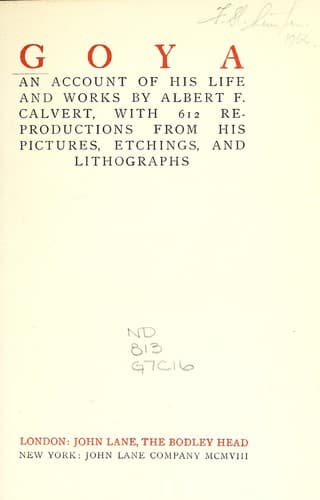
Goya, an account of his life and worksCalvert, Albert Frederick
History
Goya, an account of his life and works
Calvert, Albert Frederick
Goya, Francisco, 1746-1828
who took the match from the hands of the dead artillerymen and continued
to work the guns. Every phase of warfare, its famine and desolation, its
hunger and disease, its heroism and its savagery, are depicted in this
impeachment of Militarism. The utter uselessness of war is emphasised
in the haunting echo which runs through all the plates--‘To what end?’
The wasteful sacrifice of human lives is forced upon Goya’s audience by
an engraving in this series inscribed with the word ‘Nada’
(Nothingness). Gautier in his rare volume, _Travels in Spain_ (so rare
that I need make no apology for again quoting from it), writes of this
plate: ‘Among these drawings which admit of an easy explanation, there
is one fearfully terrible and mysterious, the meaning of which, that we
can dimly understand, fills you with horror and affright. It is a
corpse, half-buried in the earth; it is supporting itself on its elbow,
and, without looking at what it is writing, traces with its bony hand,
on a paper placed near it, one word--“Nothingness”--which is alone worth
the most terrible things Dante ever penned. Around its head, on which
there is just enough flesh left to render it more frightful than a mere
skull, flit, scarcely visible in the darkness of the night, a number of
monstrous spectres, lighted up here and there by flashes of vivid
lightning. A fatidical hand holds a pair of scales, which are in the act
of turning upside down. Can you conceive anything more sinister or more
heartrending?’
The ‘Disasters’ were not published in a series until 1863, when the
Academy of San Fernando acquired eighty plates and issued the engravings
with a brief introductory note. In this introduction the writer says:
‘The collection which Goya designated by the name of _Ravages_ or
_Disasters of War_, is indisputably one of the most notable of the kind
that he produced. In it is all the strength of his lively imagination,
exalted and excited by a deep patriotic feeling in those terrible
moments when an unjust foreign invasion essayed to humiliate the pride
and hauteur which are a characteristic of the Spaniard. What matter for
surprise then that a Spaniard, an Aragonese, a man with the stern
independent character of Goya, should allow himself to be carried away
very often by exaggeration and caricature?... On the other hand, this
work breathes novelty in the subjects, originality in the types, fire in
the composition, boldness and firmness in the colouring, decision and
even fineness in the design.... In order that nothing shall be lacking
in this collection, there is given on each plate the inscriptions which
afford another proof of the artist’s genius. These inscriptions,
concise, incisive, and piquant, add character, if that be possible, to
what the pencil had already accomplished; the brief phrases, at times a
single word, reveal by their sense of rapidity the fugitive idea which
his mind had conceived in a moment, and which, in little more than
Public-domain text, read in full here on John Shaqi.
Reviews
Reviews
No reviews yet
Be the first to share your thoughts on this work.
Elsewhere in the archive
Join the Discussion
Join the discussion
Sign in to leave a comment or review.
Sign InorCreate an account